
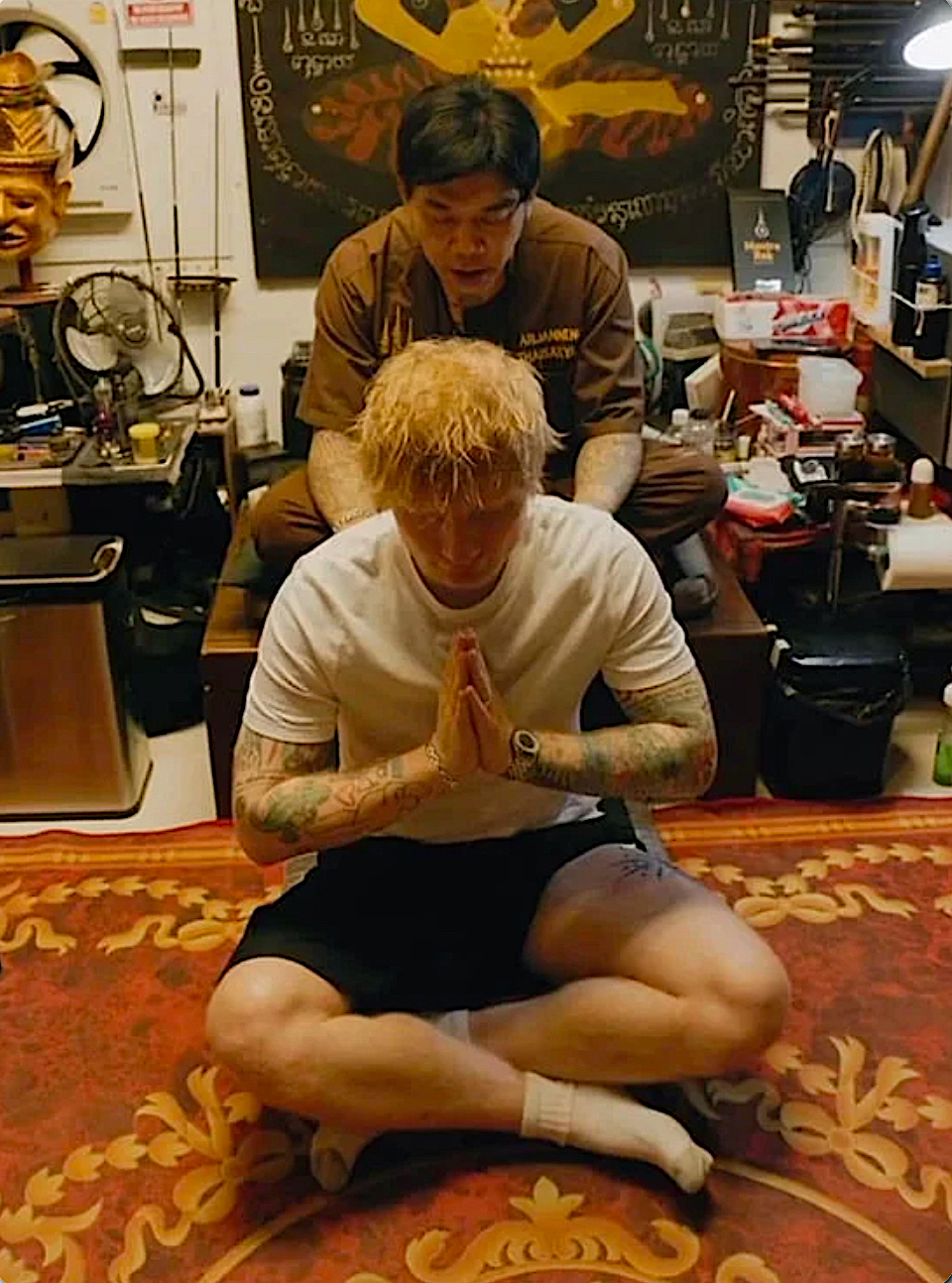
A striking contradiction has emerged in my mind surrounding the British pop superstar Ed Sheeran’s 2024 acquisition of a traditional Thai Sak Yant tattoo and the ongoing controversy engulfing his troubled and spiralling Loop Tour, a dispute that raises much broader questions about cultural appropriation, one’s spiritual commitment to Sak Yant, and the ethics of celebrity influence. During his Thailand tour in February 2024, Sheeran received a Jatutit Yantra tattoo from Ajarn Neng at a sacred studio in Bangkok. According to the Sak Yant Chiang Mai school, the design combines a modified Fon Saen Ha (Rain Talisman) with Ittipiso Paed Tidt (Eight Directions) magickal text, blessed by the respected master.
However, in my book Thai Tattoo Magick which discusses my Sak Yant pilgrimages I state;
“The heavily publicized event of Ed Sheeran acquiring a Sak Yant on his upper thigh in February 2024 reflects the tourist industry move away from flagrant debauchery and more towards Thailand’s traditions and culture…Ed Sheeran’s Jatutit Yantra, a combination of a modified Fon Saen Ha or Rain Talisman design incorporating the Ittipiso Paed Tidt (8 Directions) magickal text and blessing by the respected master Ajarn Neng, signifies this broadening of the Westerner’s concept of Thai culture to include more traditional elements.“
It is very important to note that the Paed Tidt or 8 Direction Sak Yant needs to be applied as close to the head as possible for the strongest possible protection. Being tattooed upon one’s thigh or below the waist for my mind is not in my opinion close as possible to the head, therefore any form of protection is limited and diminished by the distance to Ed Sheeran’s now somewhat besieged head. I do not wish in any way to cast aspersions against Ajarn Neng however, since the only space he had left to place this tattoo was in fact on Ed’s upper thigh. My own personal Paed Tidt or 8 Direction Sak Yant tattoo is placed in the dead centre of my upper back. I go further in my book to ask more pointed questions about Ed Sheeran’s questionable Sak Yant:
“In all honesty, my initial gut reaction to the publicity surrounding Sheeran’s Sak Yant event, which in no way reflects my feelings about highly respected Ajarn Neng, was a questioning of Sheeran’s intentions. Does Sheeran regard his Jatutit Yantra as just another tattoo among a plethora of others on his body? Or does his acquiring of a Sak Yant signify the beginning of a lasting philosophical and devotional commitment to following a specific pathway?“
Traditional Sak Yant practice is rooted in Buddhist ethics, particularly the Five Precepts: refraining from killing, stealing, sexual misconduct, false speech, and intoxicants. Academic research indicates that recipients enter into what some practitioners describe as having karmic strings attached, spiritual obligations binding them to uphold Buddhist values. According to multiple sources documenting Sak Yant tradition, high-level protective tattoos carry moral expectations extending far beyond mere aesthetic appreciation. The question arises: do these obligations extend to secular conduct affecting others’ freedom of expression? Is ignoring or acquiescing to the silencing of protest against a genocide ethical? The Buddhist precepts ask whether one’s actions reduces suffering or increases it. It is this essential realisation that we must all ask. Ed Sheeran’s Loop Tour has faced significant turbulence following the September 2026 removal of opening act Macklemore. According to reporting, the rapper performed his protest song “Hind’s Hall” during a September 5 date at New Jersey’s MetLife Stadium, calling for Palestinian freedom after describing a 5-year-old Palestinian girl killed during the Gaza war.
Before performing his 2024 protest song “Hind’s Hall“, named after Columbia University’s Hamilton Hall, which pro-Palestinian protesters renamed in honour of five-year-old Palestinian girl Hind Rajab, Macklemore told the crowd of approximately 80,000 attendees that he wanted people in Gaza and the West Bank to know they “have not been forgotten.” He concluded, “I say Free Palestine, free Cuba, Congo, Sudan and Iran and all the people of America who live in fear because of this terrorist organisation, ICE.” Artists including Dublin’s Aaron Rowe cited their countries’ historical experiences of occupation as motivation for their withdrawal from the Loop Tour. Ticket prices for Ed Sheeran’s remaining shows have plunged, with fans expressing divided opinions about continuing attendance. The intersection of these two narratives, one spiritual-cultural, the other political-commercial, raises uncomfortable questions for observers familiar with the Sak Yant tradition. Yet Ed Sheeran has maintained he has been “appalled by the conflict between Israel and Palestine” but has declined political debate, stating that the decision regarding Macklemore came from his promoters and the venues rather than himself personally. All supporting acts have since withdrawn in solidarity. The country of Ireland itself is seemingly turning its back to Ed Sheeran with certain radio stations banning his music. Ed Sheeran’s scripted and teleprompted response which fails to mention numerous aspects of this horrific genocide which has taken the lives of an estimated 21,000 children has not been received well and is viewed more as a PR move than a sincere and heartfelt apology. Questions regarding the validation of using the term ‘genocide’ have been passed and verified. In September 2025, the International Association of Genocide Scholars (IAGS), representing approximately 500 scholars, passed a resolution with 86% of voting members stating that Israel’s actions in Gaza “fulfill the definition of genocide” as set out in the 1948 UN Convention.
Some critics might argue that accepting Sak Yant while allegedly caving in to a billionaire’s pressure on artistic expression represents selective spiritual adherence. They point to the tradition’s emphasis on compassion, truthfulness, and protecting the vulnerable (this in my mind includes your fellow tour members). Defenders counter that Sak Yant blessings are culturally significant regardless of subsequent events, that Sheeran did not directly terminate Macklemore, and that expecting celebrities to embody monastic discipline misunderstands the nature of the practice. Some Thai Buddhists themselves express ambivalence about Sak Yant belonging in secular contexts. An article in Tricycle: The Buddhist Review noted that “Thai Buddhists disagree about whether or not Sak Yant even belong outside monastic settings.” From my research it is indicated that Sak Yant recipients traditionally accept moral obligations tied to the Buddhist precepts. This is something I have mindfully embodied in my life on a daily basis. However, academic scholars note interpretation varies widely, and some Thai Buddhists debate whether laypersons should receive such tattoos at all. Indeed, I see holding Sak Yant on my body as a privilege of utmost honour which I focus my daily practice upon. In my article Sak Yant: Magick Written on the Skin in New Dawn issue 218 I unequivocally write;
“There is a non-negotiable covenant involved in acquiring Sak Yant tattoos.”
These Yantra are in fact magickal spells, ‘contraptions’ and active sigils which work as a form of software on the body and mind. If one does not respect them then it will be to the wearers own detriment and chaos. Sak Yant are a philosophical commitment to following a spiritual pathway and not just some trendy addition, ‘cool’ ink or souvenir from a holiday. Beyond the specifics of Sheeran’s case, this situation highlights growing tensions around cultural commodification. As the Thai tourism industry increasingly markets spiritual authenticity alongside entertainment under the title of ‘Soft Power’, questions intensify about whether Western celebrities engage meaningfully with traditions they adopt or merely extract aesthetic value. In my book Thai Tattoo Magick my closing inquiry remains seemingly unresolved: whether Sheeran’s Jatutit Yantra represents genuine philosophical commitment or functions merely as “another tattoo among a plethora of others on his body.” As the Loop Tour continues through late 2026 amid controversy, observers worldwide watch not only for its commercial outcome but for how Sheeran addresses the ethical dimensions of both his spiritual adoption and his platform’s impact on artistic freedom. Laura Snapes in The Guardian stated; “At worst, Sheeran – who has always been open about his commercially minded approach to pop – looks like a corporate shill; at best, wilfully naive. Sheeran loves to dabble in the music of other cultures to present a toothless pan-global vision of togetherness lifted from the latter-day Coldplay playbook. But you can’t play with the aesthetics of global music without also being willing to engage in the lived reality of those cultures.” The core reason for Ed Sheeran’s substantial and harmful backlash lies in his unwillingness to meaningfully engage with the culture he has appropriated, particularly by failing to uphold the Five Precepts integral to wearing Sak Yant. I bear Sak Yant with full awareness that one’s personal conduct demands excellence, steadfastness, and integrity worthy of the practice
I now at this point sincerely feel that by not adhering to the Buddhist precepts (part of the hybrid Sak Yant script used in Sak Yant tattoos is in fact Pali, the language of the Buddhist sutras) Ed Sheeran has opened himself up to all manner of problems. Once the initial positive charge of a Sak Yant is given, usually a blessing given by the practitioner at the completion of the tattoo, one is obliged to follow a specific way of life. By not doing so I feel that the positive can turn very quickly to negative. I sincerely recommend that Ed goes back to Ajarn Neng in Thailand and has his tattoo re-blessed. One should be careful when asking for protection in terms of Sak Yant tattoos, it’s a two way street of reciprocity that requires a humble but attentive spiritual devotion and practice to essentially doing the right thing, something which in my opinion Ed Sheeran has failed to do. Whether that turning from the positive to negative manifests as a financial loss, reputational damage, karmic consequence, or some combination of all three remains to be seen in the fullness of time. What cannot be disputed is that the question itself has now entered into the public record. Sak Yant was never meant to exist in a vacuum detached from consequence. The very purpose of these tattoos is to create a relationship with Buddhism, Animism, with the Ajarn who has implemented the Sak Yant, with the ancient tradition of this powerful system, with the unseen forces invoked by the Sak Yant scripts, and ultimately with the ethical and spiritual demands that accompany them. My book Thai Tattoo Magick is published by Inner Traditions.
Sources: The Guardian, DW News, RTÉ Entertainment, Los Angeles Times, BBC News, Al Jazeera, Tricycle: The Buddhist Review, New Dawn, academic papers on Sak Yant traditions. Additional source material provided: Thai Tattoo Magick, pages 7-8.

