
“Such is ethics, such is immersion, such is wisdom. When immersion is imbued with ethics it’s very fruitful and beneficial. When wisdom is imbued with immersion it’s very fruitful and beneficial. When the mind is imbued with wisdom it is rightly freed from the defilements, namely, the defilements of sensuality, desire to be reborn, and ignorance.” – Mahāparinibbānasutta (DN 16)
The Guru Who Came Down from the Mountain
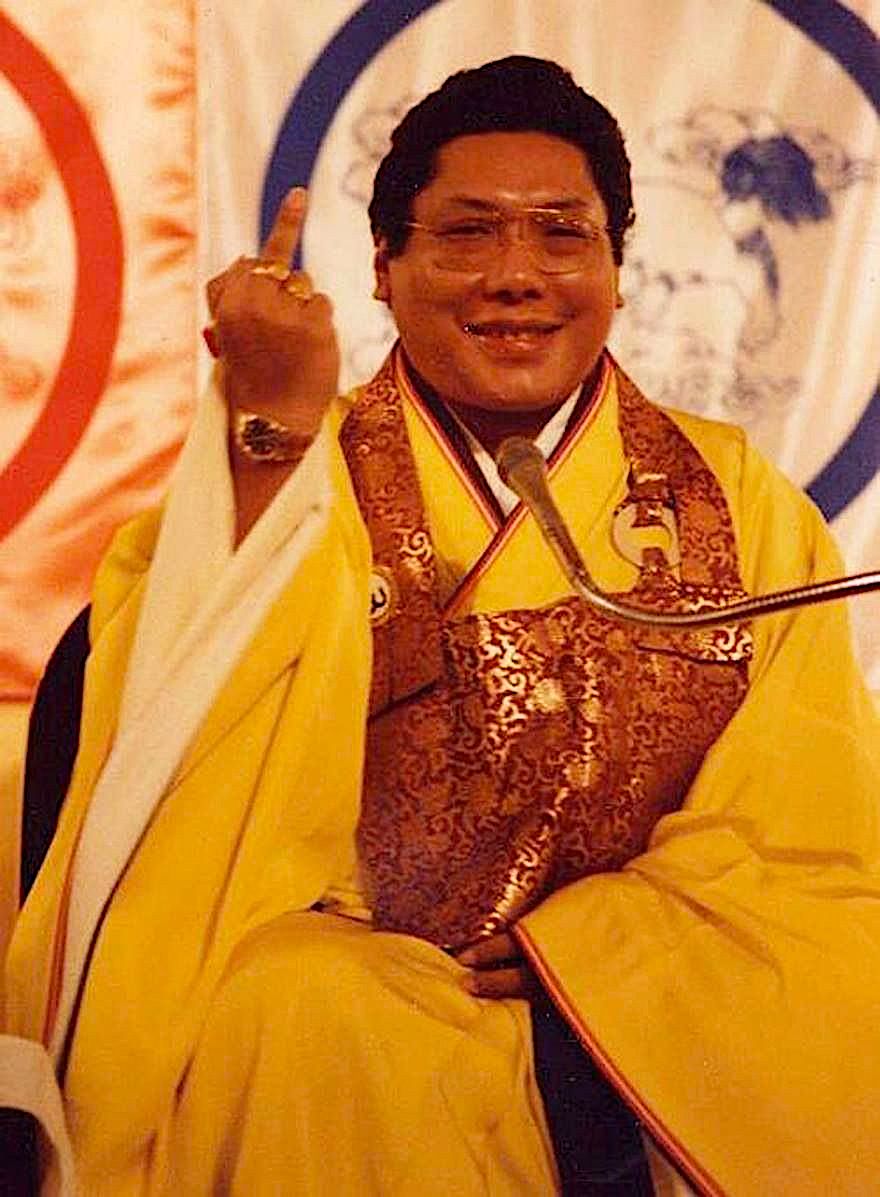
Few figures in Western Buddhism carry biographies as allegedly luminous or as haunted by abuse as Chögyam Trungpa Rinpoche.⁸ Born in eastern Tibet and enthroned as a tulku (an individual recognised as the reincarnation of a previous spiritual master) in childhood, he fled the Chinese occupation across the Himalayas and resurfaced in the West as something unprecedented: a monastery-trained Vajrayana master who drank, wore Edwardian suits, and translated an ancient esoteric tradition into a language that mesmerised a generation of seekers.⁸ He founded Naropa Institute in Boulder in 1974 and built the network of meditation centres that became Shambhala International, headquartered in Halifax and reaching roughly 200 centres worldwide.¹ He popularised the term “crazy wisdom,” distilled Buddhism into a presentation largely stripped of traditional ornament, and left behind translations, books, and devoted students.⁸ But a quieter more damning ledger runs alongside, and in 2020, The Walrus published an investigative report that finally reckoned with it: a culture of abuse reaching back to Shambhala’s earliest days, with all three of the organisation’s successive leaders, Trungpa among them, credibly accused of sexual misconduct and abuse of power.⁴ How does a teacher entrusted with one of the most demanding ethical curricula in any religion leave behind that kind of record? The answer, examined honestly, touches not only one man’s character but the architecture of authority he built, and what happens when enlightenment is offered as a reason to stop asking questions, something Buddha himself would never condone. The testimony at the heart of this comes from two sources of unusual integrity. Leslie Hays was a first-hand witness: one of Trungpa’s wives, present in the court, writing from direct experience of the events she describes. Ayya Yeshe, a fully ordained Buddhist nun since 2001, who has vowed to uphold truthfulness as one of the foundational precepts of her path, whose reflection frames Hays’ account with moral clarity. That their words first appeared as Facebook posts, Hays on January 12, 2019,² and Yeshe on September 10, 2026,⁹ does not diminish them; it places them in the long tradition of witnesses speaking plainly when official channels decline to listen. Their testimony stands alongside the documented record compiled by The Guardian, Tricycle, NPR, the Columbia Journalism Review, VTDigger, Buddhistdoor Global, and the summary maintained on Trungpa’s Wikipedia entry,⁸ each tier illuminating the other.
Three Reigns, One Blueprint
The documented record frames everything that follows. In 1970, at a Halloween party in Snowmass, Colorado, Trungpa ordered attendees stripped of their clothing. When the poet W.S. Merwin and his girlfriend refused, they were forcibly undressed before the assembled students.⁸ The incident caused controversy during Trungpa’s lifetime, but the more enduring revelation was the defence offered afterward: within his circle, the episode was explained not as assault but as teaching, a demonstration of egolessness delivered by a master with his students’ welfare in hand. Theological vocabulary, applied retroactively, performed the work of an alibi. The succession deepens the pattern. Trungpa’s chosen dharma heir, Ösel Tendzin, styled the first Western Vajra Regent, while knowingly HIV-positive, engaged in sexual relationships with his own students, several of whom alleged rape, and one of whom contracted the virus and died.⁸ A generation later, Trungpa’s son and successor, Sakyong Mipham, stepped back from his teaching and administrative duties in 2018 after the first Buddhist Project Sunshine report documented allegations of sexual assault, including claims that senior attendants known as kusung were used to procure women students for his own sexual gratification.¹ The organisation’s entire governing Kalapa Council stepped aside that year, Naropa removed Mipham from its board, and attorneys for Shambhala responded to the reports not by primarily disputing the facts but by attacking the messenger, branding them “grossly irresponsible” and the information within them “salacious” and defamatory.⁷ Three leaders, three eras, one coherent result. When a single institution reproduces the same harm across decades under different personalities, culpability migrates from biography to structure. The theology of absolute authority, with Trungpa styled by devotees a “universal monarch” receiving instruction from celestial beings, did not merely coexist with the abuse. It appears, on the documented record, to have organised it.
The Wife Who Kept the Ledger
Hays’ account matters because she was there. As one of Trungpa’s wives, she belonged to the innermost circle of the court, and her testimony offers what no external journalism could: the view from inside, recorded by someone with nothing to gain and much to lose by speaking. Her Facebook post of January 12th, 2019,² recounts the aftermath of Trungpa’s 1984 retreat, when he resolved to take additional wives. Hays, who became the fifth, describes how devotees understood these marriages as divine decree: “this decision came directly from the rigdens, who were these supposed ‘heavenly beings’ who sat around in the clouds above outer Mongolia and directed the actions of the self-proclaimed universal monarch.” Of her own position in the sequence, she writes plainly: “At first, the rigdens said he should take three more wives… But as time passed they upped the number to five. That’s when I met him. I was number five.” Ciel, the sixth, joined as a teenager, married on her eighteenth birthday. Of the relationship’s origins, Hays is categorical: “I need to say here that Ciel first slept with CT when she was very young, 13 or 14 years old. Of course people will deny this but it is the truth. She told me herself.” She continues: “Most still want to believe he was omniscient and powerful and not some pervy, rapey asshole who preyed on children. If your daughter was sleeping with the king of the universe at that age, would that be OK?” Hays describes a girl groomed from childhood, praised almost exclusively for her beauty, seated ceremonially before the court, and rumoured to be destined for Trungpa’s son. The isolation that status produced weighed on her: “CT’s special attention further isolated Ciel from the rest of us… the pressure to be number one in all actions must have been intense. The secrets she held were way too much, in my opinion, for an 18 year old who was handed over to the king of the universe and groomed since birth to marry him.” Of the community’s knowledge of the affairs that followed, she insists: “WE ALL KNEW. JESUS CHRIST WE ALL KNEW.” Hays traces Ciel’s later years: a catastrophic leg injury leading to extended narcotic dependence, a brief marriage, widowhood, a descent into addiction and psychiatric crisis, and her death from an overdose, discovered, Hays writes, in the silk pyjamas Trungpa had given her. Beauty, in that world, was treated as the whole of a woman’s worth, and Hays names the cost: “Everyone talked about how beautiful she was, and how much CT loved her. Oh, she was elegant and sophisticated and breathtakingly beautiful. Always, when Ciel was mentioned, her beauty was touted, as if she had very little value outside of that.” And of Ciel’s commodification more broadly: “Basically, sex was everywhere, and Ciel was a much prized commodity. But she wasn’t really valued for who she really was, in my opinion.” Hays writes with the humility of a careful witness, acknowledging that “my memory isn’t perfect, especially with the exact time line and order of these events,” while standing firm on the substance of what she saw and was told. Her account of a court where power flowed downward, women circulated as the perquisites of rank, and dissent was reframed as spiritual failure corresponds, in structure and in spirit, to what independent investigations documented decades later.⁴ Her closing instruction, to seek therapy outside the community, echoes the conclusion Buddhist Project Sunshine reached on a considerably larger evidentiary base: that survivors were routinely asked to subordinate their healing to the reputation of the organization that had harmed them.⁶
When the Precepts Meet the Throne
The philosophical core of this story is sharper than any individual scandal: Trungpa’s authority rested on his embodiment of Buddhist ethics, and the two cannot easily both be true. Consider the collisions. Buddhist practice, lay and monastic alike, is grounded in non-harming and restraint from sexual misconduct. However expansively one reads tantric vows for the realised, a relationship with a child of thirteen or fourteen, as Hays testifies Ciel disclosed to her, occupies no gray zone in any Buddhist school, Tibetan or Western. It is child abuse. Even the far milder documented conduct, the forced stripping at Snowmass, violates the most elementary reading of the teacher’s obligation not to harm.⁸ The bodhisattva ideal fails on its own terms. The Mahayana path Trungpa transmitted holds that a teacher’s every act should reduce suffering; the testimony and the documented record alike show a culture of abuse spanning generations, concealed and rationalised.⁴ A defence that locates the master’s realisation beyond conventional morality cannot survive an audit conducted by the visible consequences of his acts. Guru devotion, transplanted, became engineered vulnerability. In Vajrayana’s original monastic setting, devotion toward the teacher sat amid institutional checks: scholarship, community oversight, monastic discipline. Repositioned inside a hierarchical court in which questions were reframed as the questioner’s spiritual failure, the doctrine inverted into something contemporary Buddhist commentators increasingly warn about, a mechanism that converts faith into access and obedience into silence. Ayya Yeshe, in her Facebook post of September 10th, 2026,⁹ frames the dynamic with the directness of someone bound by vow to speak truth: “It was Trungpa that set up a permissive dynamic for the objectification of women and the sexualisation of teenage girls at Shambala and for the needless drug addled parties and the casual attitude to abuse that flowed on for generations there.” Of the succession, she writes: “The Sakyong was an abuser because his father was and the whole environment and culture of the organisation permitted that.” Her framing reaches toward the piece’s central thesis, that the abuse was not incidental to the culture but enabled by it: “But it’s a tale of warning, what happens when you raise a child and tell them they are a living God, isolate them from their parents and any behaviour becomes permissible in the name of feudal exoticism.” And she declines the lazy inference that this indicts Buddhism itself: “Does that mean there weren’t any good people there or that the Dharma isn’t good, no.” And “crazy wisdom” hardened into moral camouflage. Unconventional teaching methods exist authentically in Tibetan history; scholarship on the tradition’s “holy madmen” confirms it.⁸ But no school of Buddhism treats concealment, grooming, or harm to children as a diagnostic of realization. When “crazy” reliably authorizes the same pleasures, alcohol, drugs, sex with devotees, unaccountable power, it ceases to describe a teaching method and begins to describe its rationalisation.
Where the Evidence Ends and Judgement Begins
The convergent testimony of Hays and Yeshe, aligned with the documentary record, permits honest conclusions in both directions. It cannot conclude that the Dharma itself is corrupt. Millions practice these traditions ethically, and many of the most effective voices for transparency, Andrea Winn chief among them, are Buddhists pressing for reform on expressly Buddhist grounds.⁶ Neither can it conclude that Shambhala’s community was uniformly complicit; deception, good faith, and quiet conscience ran through it as thoroughly as silence did. But it can conclude this: the firsthand testimony of witnesses of demonstrated integrity, together with the corroborated record, supports the judgement that Trungpa constructed an institution whose theology of absolute authority, ritual regulation, and antinomian license predictably produced serial abuse under three successive leaders, and that women and children absorbed the cost.⁴ ⁸ That is not an indictment of Buddhism. It is the sentence Buddhist ethics itself demands be spoken aloud. Yeshe names the remedy with precision: “They know better than to ask survivors to heal a community or forgive their abusers for the sake of the organisation which victimised them in the first place…I write this with love, to anyone who is struggling with these issues, seek therapy outside of sham.”⁹ Hays’ testimony and Yeshe’s framing converge on that single imperative, and it is the note the record leaves ringing. Measured against that standard, Shambhala’s history remains open, and the telling of it is not disloyalty to the tradition. It is the tradition, being finally honoured at last.
Not celebrating, sharing or indeed posting quotes from Chögyam Trungpa Rinpoche is a clear and strong stand to take against the systemic subjugation of women and girls who were duped and forced into the drug fuelled rape and predatory paedophilia practices which were dressed-up on an industrial scale as so called spiritual enlightenment. This is not Buddhism. It is cultism. True authentic Buddhism clearly shows that this is not in any way representative of the Buddha’s teachings, which rest on the foundations of non-harm (ahimsa), ethical conduct, compassion, and right speech. No lineage claim, tantric justification, or appeal to so-called “crazy wisdom” can transform exploitation into enlightenment. Divine madness, also known as theia mania and crazy wisdom, is unconventional or unpredictable behaviour linked to spiritual pursuits. However, according to Wikipedia “It is usually explained as a manifestation of enlightened behaviour by persons who have transcended societal norms, or as a means of spiritual practice or teaching among mendicants and teachers.” It should not be a cover for sexual abuse or controlling or coercive behaviour. When teachers demand secrecy, invoke unquestioning obedience, or weaponise devotion to shield misconduct, they betray the very dharma they claim to embody. Refusing to amplify Trungpa’s words is therefore not censorship, it is discernment and the embodiment of Right Speech. It withholds legitimacy from systems that conflated charisma with realisation and authority with awakening. Genuine Buddhist communities are called to prioritise the safety and dignity of the vulnerable over the reputations of the powerful, and to hold that the measure of any teaching lies in the ethics of those who transmit it.
My book Thai Tattoo Magick is published by Inner Traditions.
References
- Buddhist group leader steps down over sexual assault claims. (2018, July 11). The Guardian.
- Hays, L. (2019, January 12th). [Testimony regarding the life of Ciel]. Facebook.
- Martin, M. (Interviewer). (2018, July 15th). A look at the #MeToo movement in the Shambhala Buddhist community [Radio interview]. NPR.
- Remski, M. (2020, September 28th). Survivors of an international Buddhist cult share their stories. The Walrus.
- Report on probe into Shambhala abuse allegations. (2018–2021). Buddhistdoor Global.
- The survivor who broke the Shambhala sexual assault story. (2019, May 7th). Columbia Journalism Review.
- Will sanghas learn from the scandals in the Buddhist world? (2025, June 10th). Tricycle: The Buddhist Review.
- Wikipedia contributors. (n.d.). Chögyam Trungpa. In Wikipedia, The Free Encyclopaedia. Retrieved September 12th, 2026.
- Yeshe, A. (2026, September 10th). [Reflection on the demise of a young woman abused at Shambhala]. Facebook.

