
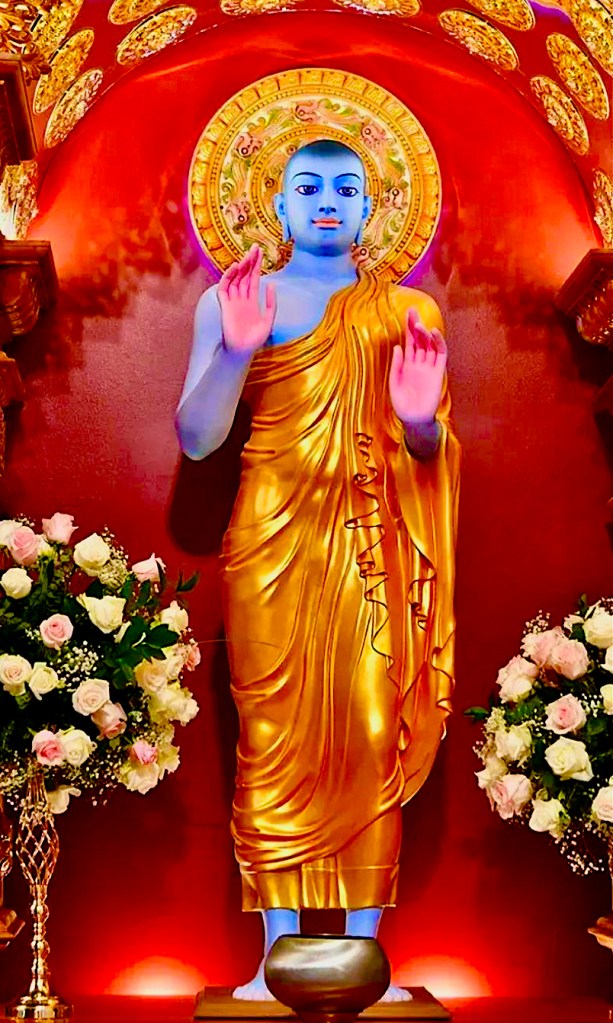
Some years ago, I stood briefly in a wat in Chiang Mai and found myself unable to stop staring at a statue. Not at the Buddha, though the central figure was, as ever, luminous and composed, but at the figure to his left. While every other disciple stood in expected natural tones, this one was painted an unmissable, almost electric blue. Not turquoise, not teal, but a deep, bruised indigo that seemed to pull light inward rather than reflect it. I asked the monk beside me. He smiled the way Thai monks smile when they know the answer will take longer than the question deserves, and said simply: “That is Phra Mahāmoggallāna.”
One of the two chief disciples of the Buddha, the other being Phra Sāriputta. The Buddha declared them a matched pair of excellence, Sāriputta foremost in wisdom (paññā), Mahāmoggallāna foremost in spiritual power (iddhi). This designation appears in the Etadaggavagga of the Aṅguttara Nikāya, and it is not a casual commendation. The Buddha was not in the habit of handing out superlatives.¹ So here is a man the Buddha himself called the greatest among his disciples in psychic potency, a being who, according to the Saṃyutta Nikāya, could descend to hell realms and ascend to heavens, interview celestials and the damned alike, multiply his body, walk on water, and pass through walls as though they were mist. Buddhaghosa, in the Visuddhimagga, leans heavily on Mahāmoggallāna’s exploits when he catalogs the varieties of supranormal power (abhiññā) available to the advanced meditator.² This is not a minor figure. This is a heavyweight. And he is blue. Why?
I think the reason the question snagged me, and continues to snag people who encounter it for the first time, is that it disrupts a particular assumption many of us carry about Buddhist art. We expect serenity. We expect golden Buddhas, serene arahants, lotuses, calm. We do not expect a blue monk standing beside the Teacher like a bruise that won’t fade. The dissonance is the point. It is meant to snag you. And once snagged, the story beneath it is one of the most theologically provocative in the entire Pāli tradition. The commentary on the Dhammapada, the Dhammapada-Aṭṭhakathā, traditionally attributed to Buddhaghosa, records that Mahāmoggallāna was beaten to death by assassins.³ Not slain in battle, not taken by illness, but beaten, bludgeoned, until his body, the most psychically formidable body in the Buddha’s retinue, was broken beyond recognition. The commentary explains that rival ascetics, resentful of the Buddha’s growing influence, commissioned the killing. Now, stop here for a moment. Because the part that should trouble you is already underway. If this man possessed the spiritual power the Buddha himself declared supreme, if he could traverse realms and reshape matter, then how was a gang of thugs with sticks able to kill him? The Buddha’s answer, preserved in the commentarial tradition, is not comforting. It is not meant to be. The story reaches back across inconceivable lifetimes. In a distant past existence, the being who would eventually become Mahāmoggallāna was a householder who, under the relentless pressure of his wife, abandoned and harmed his elderly parents. In the Buddhist ethical taxonomy, this falls under ānantarika-kamma, the five acts of immediate consequence, crimes so catastrophic that their fruit ripens in the very next life without the usual interval of delay. Matricide and patricide sit on that list alongside murdering an arahant and wounding a Buddha.⁴ This is the heaviest of karmic weights.
He repented. The tradition is emphatic about this. The remorse was genuine, the anguish real. But here is where Buddhism refuses to let us off the hook in the way we might prefer: kamma is not a forgiveness economy. Sincerity of regret does not retroactively undo the momentum (saṅkhāra) that an action of this magnitude generates. That momentum propagates, across lifetimes, across rebirths, shaping the conditions of each subsequent existence. Even after aeons of virtuous lives, even after encountering a Buddha and attaining full enlightenment, the residue of what was done persists in the conditions of the final embodiment. The blue, then. The blue is not a skin condition. It is not a stylistic flourish. It is the visual trace of upacitakamma, accumulated karma still ripening, clinging to the form of a perfected being. Purified in mind, but marked in body.⁵ Now, anyone who has spent time in Buddhist temples across Thailand, Myanmar, or Sri Lanka knows that colour in Theravāda devotional art is not naturalism. It is theological shorthand. The golden Buddha signals transcendence and luminosity (pabhassara). Sāriputta’s natural or white-ish tones evoke clarity, discernment. Mahāmoggallāna’s blue, described variously as nīla (dark blue-black) or kāḷa (dark) in classical Pali and Thai commentarial tradition, operates in a register of sombre signaling.⁶ Art historians who have worked on Northern Thai temple painting note that the blue Mahāmoggallāna appears with remarkable consistency in Lanna-era murals from roughly the 16th century onward, suggesting that by the early modern period the convention had hardened into a pedagogical fixture, a visual cue embedded in the sacred environment to provoke reflection on the universality of consequence.⁷
But here is where it gets theologically interesting, and where I think the popular retellings often miss the mark. Mahāmoggallāna was an arahant. He had eradicated all mental defilements (āsava). He had severed the roots of future rebirth. No new seeds were being planted. So how, how, could ancient karma still reach him? Buddhaghosa’s answer, which is the Theravāda orthodox answer, turns on a crucial distinction. Enlightenment destroys the causes of future becoming, the craving (taṇhā) and ignorance (avijjā) that fuel the cycle of saṃsāra. But karma already accumulated, already ripening within this present life, continues to bear fruit until the physical body itself dissolves at parinibbāna.⁸ The Milindapañha, that extraordinary dialogue between the Indo-Greek King Menander and the monk Nāgasena, frames it with characteristic directness: even an arahant is not exempt from the ripening of past deeds, though no new ones are sown.⁹
This is, I think, one of the most uncompromising passages in Buddhist thought. It says something that many traditions, religious and secular alike, find uncomfortable: that liberation does not mean escape from consequence. It means the end of creating new suffering. The old harvest still falls due. Even for a saint. Especially for a saint. And yet, and this is the part I keep returning to, if we leave it there, we have missed the point. The story of Mahāmoggallāna is not a cautionary tale designed to terrify. The Buddha did not preserve it to make us tremble. The emphasis, across both the canonical and commentarial traditions, falls not on the crushing weight of retribution but on its startling corollary: the possibility of radical, total transformation.¹⁰
Consider the arc. A man commits one of the most condemned acts in Buddhist ethics. He suffers for it across uncountable lifetimes. And he does not merely endure, he purifies. He cultivates wisdom. He encounters a Buddha. He attains enlightenment. He becomes, by the Buddha’s own declaration, the foremost among all disciples in spiritual power. The very psychic faculties that the canon attributes to him, those heaven-walking, hell-visiting, body-multiplying feats, are the faculties of a being who carried the heaviest possible karmic load and still broke through to the other shore. The blue does not mark unforgiven sin. It marks sin surpassed. Sin acknowledged, endured, and outgrown. There is a world of difference. When the devotee sees the blue figure standing beside the golden Buddha, what they are looking at is not an indictment. It is an invitation. The figure says: Look what came before. Look what became of it. The blue is the chromatic signature of the space between kamma and nibbāna, the lived, painful, and ultimately redeemable space in which we actually exist.
I think about that Chiang Mai wat sometimes. I think about the monk who smiled and said his name, knowing the question would lead here, to a story that refuses easy comfort, that insists on the arithmetic of consequence while simultaneously insisting that no sum is too large to be resolved. The blue monk standing beside the Buddha is the most honest image in the building. He says: Your past is real. Your past is heavier than you know. And still, you can walk through it. That, I sincerely think, is well worth worth staring at. My book Thai Tattoo Magick is published by Inner Traditions.
Notes
- Aṅguttara Nikāya I.24 (Etadaggavagga). See Nyanaponika Thera and Bhikkhu Bodhi, trans., Numerical Discourses of the Buddha (Walnut Creek: AltaMira Press, 1999).
- Buddhaghosa, Visuddhimagga XII–XIII (on abhiññā). See Bhikkhu Ñāṇamoli, trans., The Path of Purification (Seattle: BPS Pariyatti Editions, 1991).
- Dhammapada-Aṭṭhakathā, on Dhp v. 137. See Eugene Watson Burlingame, trans., Buddhist Legends (Cambridge, MA: Harvard University Press, 1921), Part 3. Page numbers vary by edition.
- On ānantarika-kamma, see Bhikkhu Bodhi, ed., A Comprehensive Manual of Abhidhamma (Kandy: Buddhist Publication Society, 1993), and Richard Gombrich, Theravāda Buddhism: A Social History from Ancient Benares to Modern Colombo (London: Routledge, 2006).
- For symbolic readings of Mahāmoggallāna’s appearance, see Encyclopaedia of Buddhism (Colombo: Government of Ceylon), s.v. “Moggallāna.”
- On colour symbolism in Theravāda iconography, see Martin Wickramasinghe, The Heritage of the Sinhalese (Colombo: K.V.G. de Silva, 1963), and Tanaka J., Thai Buddhist Murals: Iconography and Symbolism (Bangkok: Silpakorn University Press, 2005).
- See Piriya Krairiksh on Lanna temple painting traditions (Bangkok: Fine Arts Department, Thailand). Exact publication details vary by edition.
- Buddhaghosa, Visuddhimagga XIX (discussion of kamma-vipāka). See also Ledi Sayadaw, Manual of Buddhist Cosmology (Wheel Publications, Buddhist Publication Society, Kandy).
- Milindapañha III.7. See I.B. Horner, trans., Milinda’s Questions (London: Pali Text Society, 1963–1964).
- On karmic transformation in Pāli literature, see Steven Collins, Nirvana and Other Buddhist Felicities: Utopias of the Pali Imaginaire (Cambridge: Cambridge University Press, 1998).

