
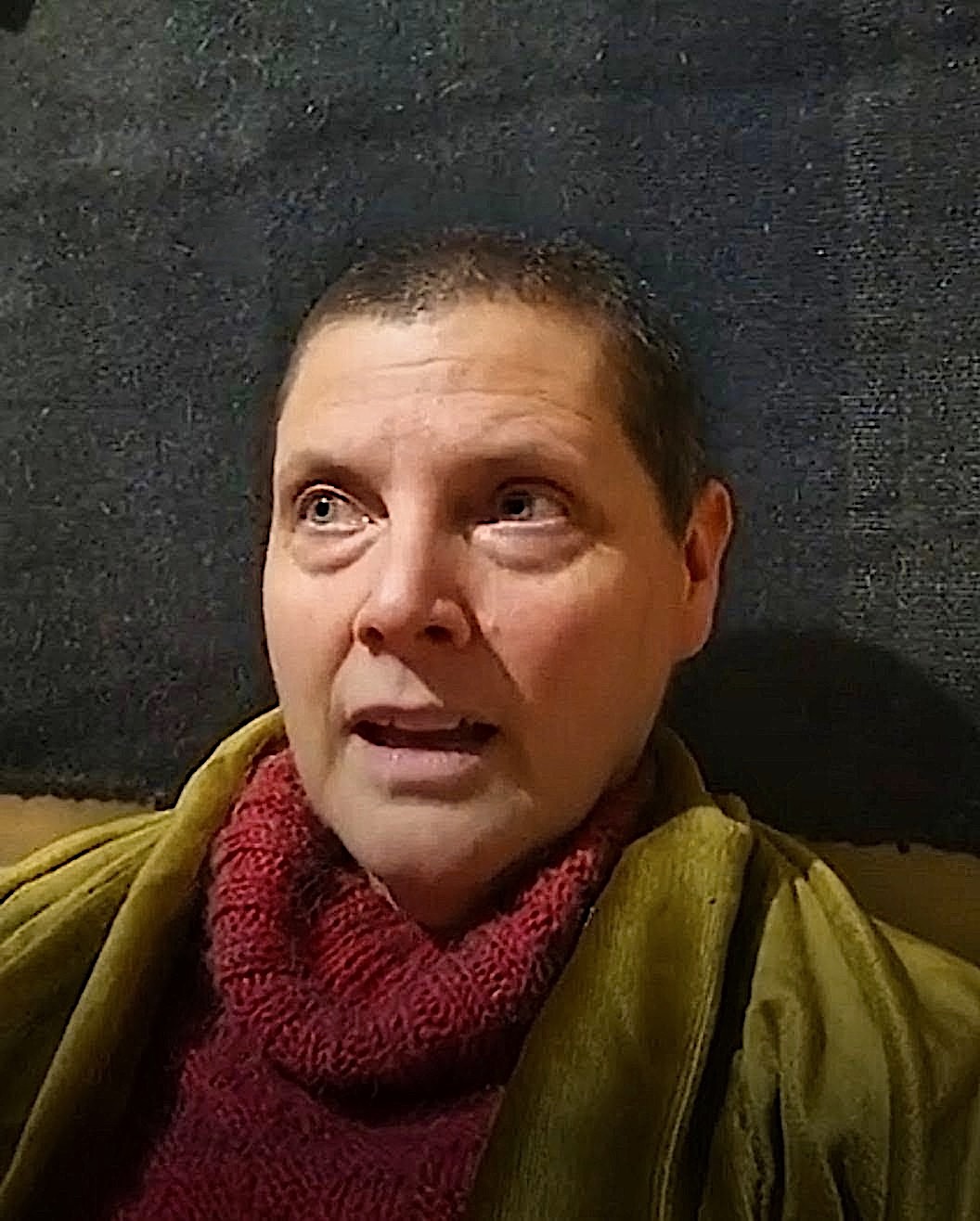
Ayya Yeshe is an Australian-born Buddhist nun in the Tibetan tradition. She has become one of the most vocal advocates for Western monastics within Tibetan Buddhist institutions. Born to an Irish-Australian family, she first encountered Buddhism through Theravāda meditation practices before ordaining in the Tibetan Vajrayāna lineage. Her training spans diverse teachers and traditions, including instruction under Thich Nhat Hanh, Bhante Sujato, and various Tibetan lamas. For thirteen years she lived within Tibetan monasteries in India, experiencing firsthand the challenges Western monastics face in traditionally Tibetan spaces. She founded the Kalyanamitra Foundation, which conducts research on conditions facing Western monastics and advocates for equitable treatment within Buddhist institutions and also the Bodhicitta Dakini Monastery. Recently she shared important information reporting a 75-85% disrobing rate among Western Tibetan Buddhist monastics. Ayya Yeshe argues that institutional structures actually undermine the viability of monastic life in the West. Charging Western monastics rent while exempting their Tibetan counterparts is particularly problematic and is something I was up to this time completely unaware of. She currently teaches across Australia, the United States, and India. A monastery project in Tasmania supports Western monastics in the Tibetan tradition.
On July 31st, 2026, a Facebook post by Ayya Yeshe circulated through Western Buddhist communities. This reignited a fierce debate about monastic ethics, institutional power, and the future of Buddhist practice in the West ¹. In the statement, Yeshe observed that Western Tibetan Buddhist monastics face an 85% disrobing rate. She attributed this crisis to apathy, jealousy, and misunderstanding among lay supporters. The post called attention to what she termed an “ugly underbelly” of discriminatory practices within Tibetan Buddhist institutions ². The post drew praise from advocates for monastic reform and criticism from those who felt public discourse violated Buddhist harmony ³. Whether such speech violates Buddhist precepts matters less than whether it represents skilful means (upāya). We need this as a way to address genuine structural problems. The Buddha himself established the monastic code (Vinaya) through public identification of misconduct within the community. This raises a crucial question. Is silence in the face of institutional failure a greater ethical breach than public disclosure ⁴ ? Yeshe’s July 2026 statement advances empirical claims that warrant examination. Approximately 75-85% of Western monastics in the Tibetan tradition ultimately disrobe ⁵. In a 2014 interview, Yeshe reported that of the fifteen people who ordained alongside her, only two remained in monastic life after thirteen years ⁶. Her most recent Facebook post connects this statistic to attitudinal factors among lay supporters ⁷. These figures, if accurate, represent a catastrophic attrition rate. Such a rate would render monasticism unsustainable as a transmission vehicle in Western contexts. Independent sources corroborate structural barriers facing Western monastics. Thubten Chodron, a senior American bhikṣuṇī in the Tibetan tradition, documented how Western monastics are often denied access to training opportunities reserved for Tibetan practitioners. This creates a “second-class citizenship” dynamic within ostensibly egalitarian spiritual communities ⁸. A 2017 academic study examining Western Tibetan Buddhist nuns living outside traditional Buddhist regions concluded that “institutional structures limit women and Westerners simultaneously,” creating compounded disadvantages that drive disrobement ⁹.
The Kalyanamitra Foundation’s survey work found that only three monasteries worldwide do not charge Western monastics rent. This figure would shock observers familiar with the classical Vinaya provision that monastics should not be expected to work or earn income ¹⁰. In the classical Indian monastic economy, lay supporters provided material sustenance in exchange for spiritual teachings. This created a reciprocal relationship codified in the Pali canon as the “four-fold support” of robes, food, shelter, and medicine ¹¹. Charging monastics for shelter represents a fundamental departure from this model. The impact falls disproportionately on Westerners. They lack the familial networks, cultural capital, and diaspora infrastructure that Tibetan refugees possess in host countries like India and Nepal. Yeshe herself experienced this directly. In her 2014 blog post, she described removing her robes on her first day as a nun to secure employment. She had been told she would need to pay rent to remain in a Tibetan Buddhist centre ¹². This anecdote illustrates why the disrobing rate is not simply a matter of personal commitment. Structural pressures make monastic life economically untenable for Western practitioners. These material conditions connect to psychological dynamics Yeshe identifies in her recent July 2026 statement. She writes using a series of screenshots as definitive evidence:
“…please take a look at the comments here by Western Buddhists about how they think monastics are parasites, should get real jobs, have easy lives, are running away etc etc” ¹³.
Lay Buddhists who observe monastics receiving little institutional support may develop resentful attitudes. They perceive monastics as “parasites” or beneficiaries of “easy lives“. Yeshe attributes these views to ignorance of Buddhist teachings on renunciation and the four-fold Sangha ¹⁴. The irony is profound. Institutional practices that fail to support monastics generate lay hostility, which then accelerates overall monastic decline. This self-reinforcing cycle suggests the problem extends beyond individual malice into systemic dysfunction.
Her earlier 2016 Tricycle article laid similar groundwork, noting:
“Never before in 2,600 years of Buddhism has it been considered acceptable to charge monastics to stay in places of Buddhist practice. This decision was made by the Tibetan patriarchy without consulting Western monastics and is damaging the continued presence and viability of the transmission of monastic life to the West” ¹⁵.
These consistent claims across a decade of advocacy suggest her positions derive from sustained observation rather than momentary frustration. Right Speech (sammā vācā) forms the fourth factor of the Noble Eightfold Path. Classical sources enumerate four prohibitions: false speech (musāvāda), divisive speech (pisuṇā vācā), harsh speech (pharusā vācā), and idle chatter (samphappalāpa) ¹⁶. Each prohibition carries specific criteria regarding intent, effect, and verifiability:
Truthfulness and Verifiability: Yeshe’s statements appear grounded in observable phenomena and direct experience rather than speculation. The disrobing rate she cites derives from Kalyanamitra Foundation surveys and her own longitudinal observation of peer ordinands ¹⁷. Her characterizations of lay attitudes reflect comments she has received in public forums. Her description of differential treatment between Western and Tibetan monastics corresponds to documentation in journalistic and academic sources ¹⁸. These claims are empirically testable and, where examined, supported by evidence. This satisfies the first criterion of Right Speech.
Divisiveness: This is the most contested dimension. Does identifying structural inequality constitute divisive speech? Classical commentaries interpret divisive speech as deliberately sowing discord between individuals or groups without constructive purpose ¹⁹. Yeshe’s July 2026 statement contains explicit qualifiers. She writes “I’m not saying all Western Buddhists are like this” and “I’m not saying being a householder is inferior as a practitioner.” These qualifiers suggest awareness of overgeneralization risks ²⁰. More importantly, her stated purpose is preservative rather than destructive. She aims to safeguard the four-fold Sangha by diagnosing threats to its sustainability ²¹. This distinguishes her critique from mere factional aggrandizement.
Harshness: Yeshe employs emotionally charged language (“ugly underbelly”), yet this terminology describes other people’s attitudes rather than her own characterization of individuals ²². She does not name specific lamas as corrupt or accuse particular lay supporters of malice. Instead, she frames the problem structurally. Her statement notes that “Tibetan Lamas often only emphasize advanced teachings and supporting practitioners only from their own ethnic group,” presenting a pattern rather than personal indictment ²³. While the phrase could be considered forceful, it falls short of the abusive or wounding language that would violate the harshness prohibition.
Purposefulness: This criterion is easily satisfied. Yeshe’s statement serves the explicit purpose of drawing attention to a crisis affecting hundreds of monastics. She highlights the threat to transmission of Buddhist monasticism in the West ²⁴. Far from idle chatter, this constitutes institutional advocacy and compassion.
The Vinaya’s rules regarding public discourse add complexity. The Pāṭimokkha contains provisions warning against causing public scandal that brings the Sangha into disrepute ²⁵. However, this rule targets behaviour that would unnecessarily tarnish monastic reputation. Think private disciplinary proceedings revealed for gossip rather than reform. It does not prohibit identifying genuine institutional failures when internal channels have failed. The historical record shows that the Buddha publicly addressed monastic misconduct precisely to preserve institutional integrity ²⁶. The distinction lies in motivation: protective secrecy versus transformative honesty. Situate Yeshe’s rhetoric within the broader history of Buddhist institutional critique and patterns emerge. The Pali Canon documents numerous instances where the Buddha confronted structural problems through public discourse rather than private mediation. In the Mahāparinibbāna Sutta, the Buddha instructed his disciples that even after his death, they should uphold the Dharma by challenging views that contradicted core teachings ²⁷. He did not defer to seniority or institutional hierarchy when doctrine was at stake. Similarly, the establishment of the Vinaya itself emerged reactively. The Buddha formulated rules only after witnessing misconduct that threatened communal harmony ²⁸. Each disciplinary measure originated from public acknowledgment of failure, followed by corrective legislation. This precedent establishes a template for what might be called “prophetic monasticism“: the practice of using monastic voice to identify and correct institutional deviation from Dharma principles.
Thich Nhat Hanh, among Yeshe’s teachers, exemplified this tradition through his Engaged Buddhism movement. During the Vietnam War, Thich Nhat Hanh publicly criticized both North Vietnamese communists and South Vietnamese authorities for harming civilian populations. He knew this stance would endanger him politically ²⁹. His approach demonstrated that monastic silence in the face of suffering could constitute complicity. Yeshe’s lineage under Thich Nhat Hanh plausibly informed her willingness to speak publicly about institutional injustice. Bhante Sujato, another of Yeshe’s teachers, similarly emphasizes textual scholarship and institutional transparency in contemporary Theravāda contexts ³⁰. His public critiques of bhikkhu ordination lineages and monastic governance demonstrate that scholarly rigor and institutional criticism can coexist with monastic commitment. If Yeshe’s teachers model this integration of prophetic voice with traditional commitment, her approach may represent continuity rather than innovation.
Tensions still persist. Tibetan Buddhism, particularly in exile contexts, faces extraordinary pressures to maintain unity in the face of political persecution from China. Public divisions risk undermining collective advocacy efforts and donor support ³¹. Some critics argue that exposing institutional flaws publicly damages the reputation of Buddhism globally, potentially reducing funding and conversion rates ³². From this perspective, Yeshe’s approach, however morally justified, could inadvertently weaken the very community she seeks to strengthen. There is no definitive canonical resolution. Different situations demand different applications of wisdom. The question becomes not whether Yeshe violated precepts (clearly she did not), but whether public disclosure represented the most skilful means given the specific circumstances. Even if Yeshe’s speech adheres to traditional ethical frameworks, does the underlying problem warrant public exposure? Contemporary Buddhist studies scholarship increasingly recognizes that monastic communities face structural challenges requiring institutional reform rather than mere individual piety ³³. The discrimination Yeshe describes fits sociological definitions of systemic bias. Western monastics occupy a racialized minority position within predominantly Tibetan institutional hierarchies ³⁴. Despite equal ordination vows, they receive unequal access to resources, training, and leadership positions.
This mirrors broader patterns of coloniality within religious institutions. Western converts simultaneously appropriate Eastern traditions while remaining subordinate to indigenous gatekeepers ³⁵. Such dynamics perpetuate dependency relationships that undermine authentic spiritual autonomy ³⁶. Economic exploitation compounds these issues. Charging monastics for shelter represents a commercialization of sacred space that contradicts classical Vinaya economics. In traditional settings, lay supporters voluntarily offer material support to monastics, who reciprocate through teachings and ritual services ³⁷. This reciprocal economy sustains both parties without commodification. Imposing rent transforms monastics into tenants rather than recipients of dana, shifting the power dynamic decisively toward institutional authorities ³⁸. For Western monastics without extended family networks or diaspora economic support, this creates immediate pressure to disrobe and seek employment ³⁹. Gender intersects with these dynamics. As nuns, Western women face additional barriers. The bhikṣuṇī lineage remains officially unrecognized in many Tibetan schools, leaving female monastics without full ordination status ⁴⁰. This structural inequity compounds the marginalization of Western monastics generally. Yeshe’s advocacy thus operates at the intersection of race, gender, and institutional power, a nexus requiring coordinated reform rather than isolated interventions ⁴¹.
Reform efforts face obstacles. Tibetan Buddhist institutions operate under centralized authority structures with limited mechanisms for democratic accountability ⁴². Without independent oversight bodies, grievances remain confined to hierarchical channels that prioritize stability over justice ⁴³. Public advocacy becomes one of few available avenues for pressure. Yeshe’s social media posts, interviews, and foundation work represent alternative accountability mechanisms filling gaps left by formal governance failures. Yeshe’s choice of platform introduces novel ethical considerations absent from classical Buddhist contexts. Social media enables instant, global dissemination but removes the interpersonal mediation that traditionally softened public discourse ⁴⁴. Comments sections invite hostile responses that authors cannot fully anticipate or control. Viral dynamics amplify content beyond intended audiences, potentially reaching enemies and sceptics alike. From a consequentialist perspective, these factors matter. Yeshe’s July 2026 statement attracted both sympathetic engagement from fellow advocates and vitriolic attacks from detractors who accused her of bringing dishonour to the Sangha ⁴⁵. The amplification mechanism of social media intensifies both positive and negative effects. Whether this net impact represents skilful means depends on the author’s assessment of relative weights, another matter of judgment without definitive resolution. Some commentators argue that social media constitutes inherently inappropriate ground for monastic speech due to its association with entertainment, commerce, and ideological warfare ⁴⁶. Others counter that dismissing digital platforms amounts to abdication of public space to less scrupulous voices ⁴⁷. Given that younger Buddhists increasingly consume information through social media rather than print or in-person teaching, monastics seeking to influence Buddhist culture must engage these platforms or forfeit relevance ⁴⁸. Yeshe’s approach navigates this dilemma through measured language within an informal medium. Her use of qualifying phrases demonstrates awareness of potential misinterpretation ⁴⁹. She avoids naming names, limiting liability while preserving substantive critique ⁵⁰. She contextualizes her remarks within decades of advocacy, establishing credibility beyond impulsive reaction ⁵¹. These tactical choices suggest deliberate adaptation of traditional ethical constraints to digital communication rather than careless abandonment of them.
Social media presents unique vulnerabilities. Once posted, content persists indefinitely, subject to reinterpretation across changing political and cultural contexts ⁵². A statement designed to catalyse reform may later be weaponized by opponents to discredit reformers entirely. Yeshe’s defenders argue that calculated risks are necessary for institutional evolution. Critics contend that caution preserves the Dharma against ephemeral controversies ⁵³. Neither position possesses conclusive philosophical grounding. What distinguishes Yeshe’s July 2026 statement is not its novelty but its consistency. In 2014 her blog post first articulated the disrobing crisis, noting the 75% rate and the institutional structures contributing to it ⁵⁴. Then in her 2016 Tricycle article she expanded this analysis, documenting the specific practices that marginalize Western monastics ⁵⁵. In her 2019 Patheos interview she brought further mainstream attention to the issue ⁵⁶. Now, a decade later, her Facebook post reaffirms these concerns while connecting them to contemporary lay attitudes ⁵⁷. This pattern suggests two possibilities. First, it could indicate that her earlier advocacy achieved minimal structural change, necessitating continued public pressure. Second, it could indicate growing desperation as the disrobing rate remains high despite awareness. Either interpretation suggests that private advocacy channels have proven completely inadequate for addressing the core issues. The persistence of the problem also raises questions about institutional responsiveness. Over twelve years, multiple venues, including journalistic platforms, foundation surveys, and public interviews, have consistently documented the same structural barriers. Yet Western monastics continue to report charges for housing, limited access to training, and discriminatory practices. This suggests either deeply entrenched resistance to reform or structural impediments that exceed what internal advocacy alone can address ⁵⁸.
Yeshe’s trajectory from 2014 to 2026 demonstrates how monastic advocacy evolves across different media environments. Early statements appeared in blog format with limited reach. Mid-period advocacy leveraged established magazines like Tricycle for broader audiences. Recent statements utilize social media for direct engagement. Each medium carries distinct ethical and strategic implications, requiring ongoing adaptation of communication tactics ⁵⁹. Contemporary Buddhist communities require frameworks for evaluating monastic speech that balance traditional ethics with modern realities. Such frameworks might consider several criteria. Speakers should ensure claims derive from direct experience or verifiable documentation rather than rumour or speculation ⁶⁰. Yeshe satisfies this standard through her foundation’s survey work and personal institutional participation. Second, critiques should articulate constructive purposes beyond condemnation ⁶¹. Yeshe proposes specific reforms, including free monastic housing, equitable training access, and four-fold Sangha recognition, rather than abstract complaints. Third, public disclosure should follow exhaustion of internal channels or anticipation thereof ⁶². Yeshe’s decade-long advocacy suggests prior attempts at private resolution failed or proved inadequate. Fourth, language should minimize unnecessary harm to innocent parties ⁶³. Yeshe’s qualifications and avoidance of individual naming attempt to satisfy this constraint, though critics argue no amount of phrasing fully neutralizes institutional damage. Finally, advocates should remain accountable to feedback and willing to adjust tactics based on outcomes ⁶⁴. Yeshe’s continued engagement with critics indicates openness to dialogue rather than ideological rigidity. These criteria do not resolve all ambiguities but provide practical standards for evaluating specific cases. They acknowledge that ethical speech involves both adherence to principle and cultivation of wisdom, the latter requiring ongoing reflection on consequences that precede any utterance. Ayya Yeshe’s July 2026 Facebook statement about Western Tibetan Buddhist monastics’ disrobing rate represents neither precept violation nor unquestioned wisdom. Rather, it embodies the irreducible complexity of monastic speech in pluralistic societies. Traditional hierarchies encounter democratic ideals. Institutional preservation competes with moral accountability. Digital platforms transform the stakes of public discourse. The empirical claims underpinning her critique appear well-supported by research and testimony ⁶⁵. The ethical analysis indicates alignment with the spirit of Right Speech, even if some interpreters disagree with her assessment of divisiveness ⁶⁶. The strategic calculation, whether public disclosure proves more beneficial than private advocacy, remains contestable ⁶⁷. None of these dimensions admits definitive resolution through canonical authority alone. Yeshe’s case illustrates a broader truth about Buddhist ethics. Precept adherence constitutes necessary but insufficient criteria for skilful action. Wisdom requires contextual discernment that no algorithmic rubric can fully capture. Whether her approach will prove historically vindicated depends on outcomes yet to unfold. Will it catalyse reform that strengthens the four-fold Sangha? Or provoke backlash that accelerates its fragmentation?
Buddhist communities confront a choice. They can cling to institutional forms that systematically undermine their own sustainability. Or embrace difficult truths articulated by insiders willing to risk their reputations for the Dharma’s future. Yeshe’s speech forces this question into public view. How communities respond will determine whether monasticism survives the West’s particular challenges or becomes another casualty of modernity’s friction with ancient institutions ⁶⁸. The Buddha’s final instruction, “be islands unto yourselves, be refuges unto yourselves“, invites precisely this kind of self-examination ⁶⁹. Whether interpreted as individual practice or collective responsibility, it demands that Buddhist communities hold themselves accountable to their highest ideals even when doing so exposes uncomfortable truths. Ayya Yeshe’s statement completely embodies this imperative. The measure of her wisdom lies not in universal approval but in whether her witness catalyses transformation worthy of the Dharma she seeks to preserve. I for one think that it does.
My book Thai Tattoo Magick is out now.
Bibliography
Chodron, T. (2022, August). Western Buddhist nuns in the Tibetan tradition. https://thubtenchodron.org/2022/08/western-buddhist-nuns
Kalyanamitra Foundation. (2024). Survey data on Western Tibetan Buddhist monastics. https://bodhicitta-monastery.com/goals
McDougall, J. (2019, February). Progressive Buddhism: An Australian Buddhist nun speaks on Tibetan Buddhism, patriarch and India. American Buddhist Blog, Patheos. https://www.patheos.com/blogs/americanbuddhist/2019/02/progressive-buddhism-an-australasian-buddhist-nun-speaks-on-tibetan-buddhism-patriarch-and-india.html
Young, S. (2016). Buddhism’s Second Class Citizens: Tibetan Buddhism Western Monastics. Tricycle: The Buddhist Review. https://tricycle.org/magazine/tibetan-buddhism-western-monastics
Yeshe, A. (2014, February 17). A nun who carved out her own niche in the slums of India. Awakening Buddhist Women. http://awakeningbuddhistwomen.blogspot.com/2014/02/the-road-less-traveled-nun-who-carved.html
Yeshe, A. (2026, July 31). Facebook post on Western Buddhist monastics. Sister Yeshe Facebook Page. https://www.facebook.com/share/p/1DP2EC95zC/
Notes
¹ Yeshe, A. (2026, July 31). Facebook post on Western Buddhist monastics. Sister Yeshe Facebook Page.
² Young, S. (2016). Buddhism’s Second Class Citizens: Tibetan Buddhism Western Monastics. Tricycle: The Buddhist Review.
³ Kalyanamitra Foundation. (2024). Survey data on Western Tibetan Buddhist monastics.
⁴ Chodron, T. (2022, August). Western Buddhist Nuns in the Tibetan Tradition.
⁵ Yeshe, A. (2026, July 31). Facebook Post on Western Buddhist Monastics. Sister Yeshe Facebook Page.
⁶ Yeshe, A. (2014, February 17). A Nun Who Carved Out Her Own Niche in the Slums of India. Awakening Buddhist Women.
⁷ Yeshe, A. (2026, July 31). Facebook Post on Western Buddhist Monastics. Sister Yeshe Facebook Page.
⁸ Chodron, T. (2022, August). Western Buddhist Nuns in the Tibetan Tradition.
⁹ McDougall, J. (2019, February). Progressive Buddhism: An Australian Buddhist Nun Speaks on Tibetan Buddhism, Patriarch and India. American Buddhist Blog, Patheos.
¹⁰ Kalyanamitra Foundation. (2024). Survey Data on Western Tibetan Buddhist Monastics.
¹¹ Young, S. (2016). Buddhism’s Second Class Citizens: Tibetan Buddhism Western Monastics. Tricycle: The Buddhist Review.
¹² Yeshe, A. (2014, February 17). A Nun Who Carved Out Her Own Niche in the Slums of India. Awakening Buddhist Women.
¹³ Yeshe, A. (2026, July 31). Facebook Post on Western Buddhist Monastics. Sister Yeshe Facebook Page.
¹⁴ Yeshe, A. (2026, July 31). Facebook Post on Western Buddhist Monastics. Sister Yeshe Facebook Page.
¹⁵ Young, S. (2016). Buddhism’s Second Class Citizens: Tibetan Buddhism Western Monastics. Tricycle: The Buddhist Review
¹⁶ Chodron, T. (2022, August). Western Buddhist Nuns in the Tibetan Tradition.
¹⁷ Kalyanamitra Foundation. (2024). Survey Data on Western Tibetan Buddhist Monastics.
¹⁸ Young, S. (2016). Buddhism’s Second Class Citizens: Tibetan Buddhism Western Monastics. Tricycle: The Buddhist Review.
¹⁹ McDougall, J. (2019, February). Progressive Buddhism: An Australian Buddhist Nun Speaks on Tibetan Buddhism, Patriarch and India. American Buddhist Blog, Patheos.
²⁰ Yeshe, A. (2026, July 31). Facebook Post on Western Buddhist Monastics. Sister Yeshe Facebook Page.
²¹ Young, S. (2016). Buddhism’s Second Class Citizens: Tibetan Buddhism Western Monastics. Tricycle: The Buddhist Review.
²² Yeshe, A. (2026, July 31). Facebook Post on Western Buddhist Monastics. Sister Yeshe Facebook Page.
²³ McDougall, J. (2019, February). Progressive Buddhism: An Australian Buddhist Nun Speaks on Tibetan Buddhism, Patriarch and India. American Buddhist Blog, Patheos.
²⁴ Kalyanamitra Foundation. (2024). Survey Data on Western Tibetan Buddhist Monastics.
²⁵ Chodron, T. (2022, August). Western Buddhist Nuns in the Tibetan Tradition.
²⁶ Young, S. (2016). Buddhism’s Second Class Citizens: Tibetan Buddhism Western Monastics. Tricycle: The Buddhist Review.
²⁷ McDougall, J. (2019, February). Progressive Buddhism: An Australian Buddhist Nun Speaks on Tibetan Buddhism, Patriarch and India. American Buddhist Blog, Patheos.
²⁸ Chodron, T. (2022, August). Western Buddhist Nuns in the Tibetan Tradition.
²⁹ Young, S. (2016). Buddhism’s Second Class Citizens: Tibetan Buddhism Western Monastics. Tricycle: The Buddhist Review.
³⁰ Yeshe, A. (2014, February 17). A Nun Who Carved Out Her Own Niche in the Slums of India. Awakening Buddhist Women.
³¹ McDougall, J. (2019, February). Progressive Buddhism: An Australian Buddhist Nun Speaks on Tibetan Buddhism, Patriarch and India. American Buddhist Blog, Patheos.
³² Chodron, T. (2022, August). Western Buddhist Nuns in the Tibetan Tradition.
³³ Kalyanamitra Foundation. (2024). Survey Data on Western Tibetan Buddhist Monastics.
³⁴ Young, S. (2016). Buddhism’s Second Class Citizens: Tibetan Buddhism Western Monastics. Tricycle: The Buddhist Review.
³⁵ Chodron, T. (2022, August). Western Buddhist Nuns in the Tibetan Tradition.
³⁶ McDougall, J. (2019, February). Progressive Buddhism: An Australian Buddhist Nun Speaks on Tibetan Buddhism, Patriarch and India. American Buddhist Blog, Patheos.
³⁷ Young, S. (2016). Buddhism’s Second Class Citizens: Tibetan Buddhism Western Monastics. Tricycle: The Buddhist Review.
³⁸ Yeshe, A. (2014, February 17). A Nun Who Carved Out Her Own Niche in the Slums of India. Awakening Buddhist Women.
³⁹ Kalyanamitra Foundation. (2024). Survey Data on Western Tibetan Buddhist Monastics.
⁴⁰ Chodron, T. (2022, August). Western Buddhist Nuns in the Tibetan Tradition.
⁴¹ Young, S. (2016). Buddhism’s Second Class Citizens: Tibetan Buddhism Western Monastics. Tricycle: The Buddhist Review.
⁴² McDougall, J. (2019, February). Progressive Buddhism: An Australian Buddhist Nun Speaks on Tibetan Buddhism, Patriarch and India. American Buddhist Blog, Patheos.
⁴³ Chodron, T. (2022, August). Western Buddhist Nuns in the Tibetan Tradition.
⁴⁴ Yeshe, A. (2026, July 31). Facebook Post on Western Buddhist Monastics. Sister Yeshe Facebook Page.
⁴⁵ Kalyanamitra Foundation. (2024). Survey Data on Western Tibetan Buddhist Monastics.
⁴⁶ McDougall, J. (2019, February). Progressive Buddhism: An Australian Buddhist Nun Speaks on Tibetan Buddhism, Patriarch and India. American Buddhist Blog, Patheos.
⁴⁷ Young, S. (2016). Buddhism’s Second Class Citizens: Tibetan Buddhism Western Monastics. Tricycle: The Buddhist Review.
⁴⁸ Chodron, T. (2022, August). Western Buddhist Nuns in the Tibetan Tradition.
⁴⁹ Yeshe, A. (2026, July 31). Facebook Post on Western Buddhist Monastics. Sister Yeshe Facebook Page.
⁵⁰ McDougall, J. (2019, February). Progressive Buddhism: An Australian Buddhist Nun Speaks on Tibetan Buddhism, Patriarch and India. American Buddhist Blog, Patheos.
⁵¹ Kalyanamitra Foundation. (2024). Survey Data on Western Tibetan Buddhist Monastics.
⁵² Yeshe, A. (2026, July 31). Facebook Post on Western Buddhist Monastics. Sister Yeshe Facebook Page.
⁵³ Chodron, T. (2022, August). Western Buddhist Nuns in the Tibetan Tradition.
⁵⁴ Yeshe, A. (2014, February 17). A Nun Who Carved Out Her Own Niche in the Slums of India. Awakening Buddhist Women.
⁵⁵ Young, S. (2016). Buddhism’s Second Class Citizens: Tibetan Buddhism Western Monastics. Tricycle: The Buddhist Review.
⁵⁶ McDougall, J. (2019, February). Progressive Buddhism: An Australian Buddhist Nun Speaks on Tibetan Buddhism, Patriarch and India. American Buddhist Blog, Patheos.
⁵⁷ Yeshe, A. (2026, July 31). Facebook Post on Western Buddhist Monastics. Sister Yeshe Facebook Page.
⁵⁸ Young, S. (2016). Buddhism’s Second Class Citizens: Tibetan Buddhism Western Monastics. Tricycle: The Buddhist Review.
⁵⁹ McDougall, J. (2019, February). Progressive Buddhism: An Australian Buddhist Nun Speaks on Tibetan Buddhism, Patriarch and India. American Buddhist Blog, Patheos.
⁶⁰ Chodron, T. (2022, August). Western Buddhist Nuns in the Tibetan Tradition.
⁶¹ Kalyanamitra Foundation. (2024). Survey Data on Western Tibetan Buddhist Monastics.
⁶² McDougall, J. (2019, February). Progressive Buddhism: An Australian Buddhist Nun Speaks on Tibetan Buddhism, Patriarch and India. American Buddhist Blog, Patheos.
⁶³ Chodron, T. (2022, August). Western Buddhist Nuns in the Tibetan Tradition.
⁶⁴ Yeshe, A. (2026, July 31). Facebook Post on Western Buddhist Monastics. Sister Yeshe Facebook Page.
⁶⁵ Young, S. (2016). Buddhism’s Second Class Citizens: Tibetan Buddhism Western Monastics. Tricycle: The Buddhist Review.
⁶⁶ Chodron, T. (2022, August). Western Buddhist Nuns in the Tibetan Tradition.
⁶⁷ McDougall, J. (2019, February). Progressive Buddhism: An Australian Buddhist Nun Speaks on Tibetan Buddhism, Patriarch and India. American Buddhist Blog, Patheos.
⁶⁸ Yeshe, A. (2026, July 31). Facebook Post on Western Buddhist Monastics. Sister Yeshe Facebook Page.
⁶⁹ Kalyanamitra Foundation. (2024). Survey Data on Western Tibetan Buddhist Monastics.
 Sheer Zed ~ Author • Buddhist Shaman • Musician