
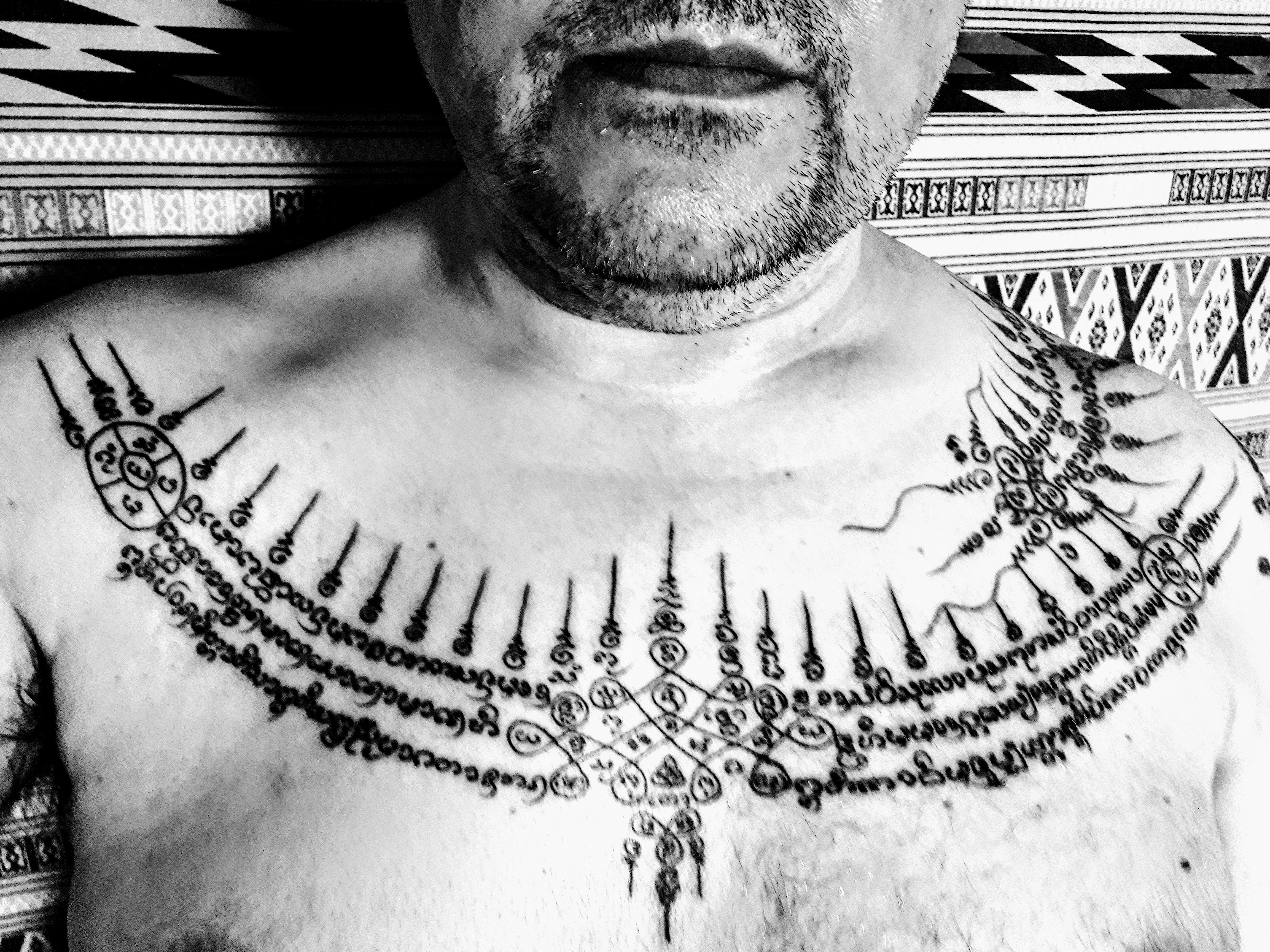
In light of recent events I felt it was necessary to write about the rules surrounding Sak Yant. It is indeed very heartening to see Sak Yant, the Thai art of yantra tattooing, slowly but surely continue to forge its way permanently into mainstream global culture. It has now even gone on recently to spiritually supersize the culinary design delights of the toasted bun for the truly surreal phenomena of a Buddhist sacred-tattoo burger (which in truth does seem a touch somewhat incongruous and at odds with certain schools of Buddhist thought that practice vegetarianism). It would now therefore be pertinent and timely to remind ourselves of some of the basic and underlying rules, obligations and requirements that the wearers of Sak Yant tattoos or “skin garments” (as noted by Chinese observers in the 4th century) have to the lineages who have gifted these sacred magickal symbols to their devotees. In Daniel IIan Cohen Thin’s perceptive Spring 2022 article The Fine Print on Thai Tattoos, he notes that there are “karmic strings attached” to receiving Sak Yant tattoos. I would go further than this. There is a non-negotiable covenant involved with acquiring Sak Yant tattoos. While there is indeed no simple answer as to the question ‘Are Western Sak Yant wearers unknowingly converting to Buddhism?’ it is essential to look a little deeper into what Sak Yant actually are. My personal experiences, which have been extensively documented in my recent book Thai Tattoo Magick, draws into the wider view of this subject the context of having such magickal diagrammatic geometric contraptions (the term yantra has various meanings from machine, instrument, appliance, device, engine or even as far as the term motor) which are physically branded onto the skin using a metal rod (Khem Sak) in situ, in a ritual that is at best a highly charged and an extremely intense event and ordeal. I often like to view Sak Yant as a kind of Buddhist and animist magickal software on the hardware of the human body. It invades the psyche, eventually making unseen, subtle and permanent reconfigurations within the very character and sphere of causality of the wearer. You can choose to accept or indeed deny the changes but is of course ultimately something that is deemed desirable by the teacher who has implemented these remarkable designs onto your flesh if you accept. This is after all, if you will, an encrypted magickal sigil that gifts the wearer exceptional magickal functionalities and life-changing transformations.
Choosing my own Sak Yant, at the beginning of the seven year period of my four separate pilgrimages to Thailand, was something that I felt was important, since it was a motivation that came from a blend of both meditation and instinct. However, Ajarn practitioners are known to be able to ‘diagnose’ which Sak Yant tattoos are required for any one devotee in order to evolve and progress any form of spiritual growth. At the beginning of this eventful odyssey I was really not that interested in acquiring Sak Yant at all and only wished to focus on the magickal healing rituals that were offered to me. It was Ajarn Nanting however that gave me my very first Sak Yant. It was an ‘invisible’ Sak Yant (made from a variety of sacred oils), which embodied the deity Mae Surasatee, the Goddess of wisdom and good luck, the deva that rides a swan, the deity in charge of Buddhist scriptures, knowledge and music. The ritual was one of the most electric and mind-blowing experiences I’d had up to this point in my life. It literally knocked me sideways. The combination of endomorphins, the setting of a Thai/Burmese style shrine engorged with spirits and a powerful and charismatic practitioner driving a metal rod into the upper centre of my back was undeniably life-changing. It was a ritual of spiritual awakening. The then recent death of my father weighed heavily on my being and this peak experience wiped away the mixed and difficult grief that I was going through. Yes, we have all seen the endless photographs of happy, smiling and delighted people after their Sak Yant has been given often pass us by on social media.
And yet, one must be mindful and remember that authentic Sak Yant is initiated in front of a fully consecrated Buddhist shrine of various components, very a sacred, calm and spiritually active space of ritual. True, Sak Yant is initiated not inside a tattoo parlour or indeed from someone who has not previously been ordained as a Buddhist monk or has just a shallow surface of knowledge, understanding and lacking the essential master and student bonding and lineage. It is not just some cut and paste cultural souvenir or a passing fad. It is initiation into a devotional commitment to a spiritual philosophy stretching back thousands of years. The enchanting and incredibly ornate shrines inside samnaks (the place of work for practitioners of Sak Yant) are powerful and fertile energy centres embodying spirits, monks, effigies of past masters, deities, Lersi (a mystical hermit or ascetic) and at the very top of all samnaks Buddha, of which nothing is ever higher than, the great spiritual teacher at the very heart of Buddhism. Buddhism and animism beautifully merge together in South-East Asian philosophy and very often become interwoven into a unique and complex spiritual landscape. The shrine at which a devotee sits while receiving Sak Yant will very often inform the devotee during the ritual in many unseen ways. I have personally experienced visions and gone into trance states during the application of Sak Yant. These have been both informational, inspirational and on occasion perplexing. While certain quarters wish to downplay the Buddhist aspects of Sak Yant, I have embraced them, accept them and ultimately defend them for what they are. These tattoos have specific rules to abide by and cannot be applied by an untrained tattoo artist. One of my teachers, Ajarn Daeng, named the master of master’s by his peers, has clear instructions on his wall in the form of a sign that includes the holding of the Five Precepts. Here are the rules verbatim as written on Ajarn Daeng’s wall;
Do not eat the meat of a dog or a snake, the food from an altar or left over food from someone else. Do not walk under clothes lines, under the stairs or steps and do not go under banana trees. Do not disrespect Parents or Ajarns. Please keep the five precepts, especially the third precept concerning not having an affair. Please say kata (mantra) every day. If your Yants have no kata, then say Namo Tassa (Namo Tassa Bhagavato Arahato Sammāsambuddhassa) to The Buddha please. If any rules are broken, please return to the Samnak and make an offering of flowers,incense and candles to the altar and bathe in Sompoi to cleanse the Yants of defilement.
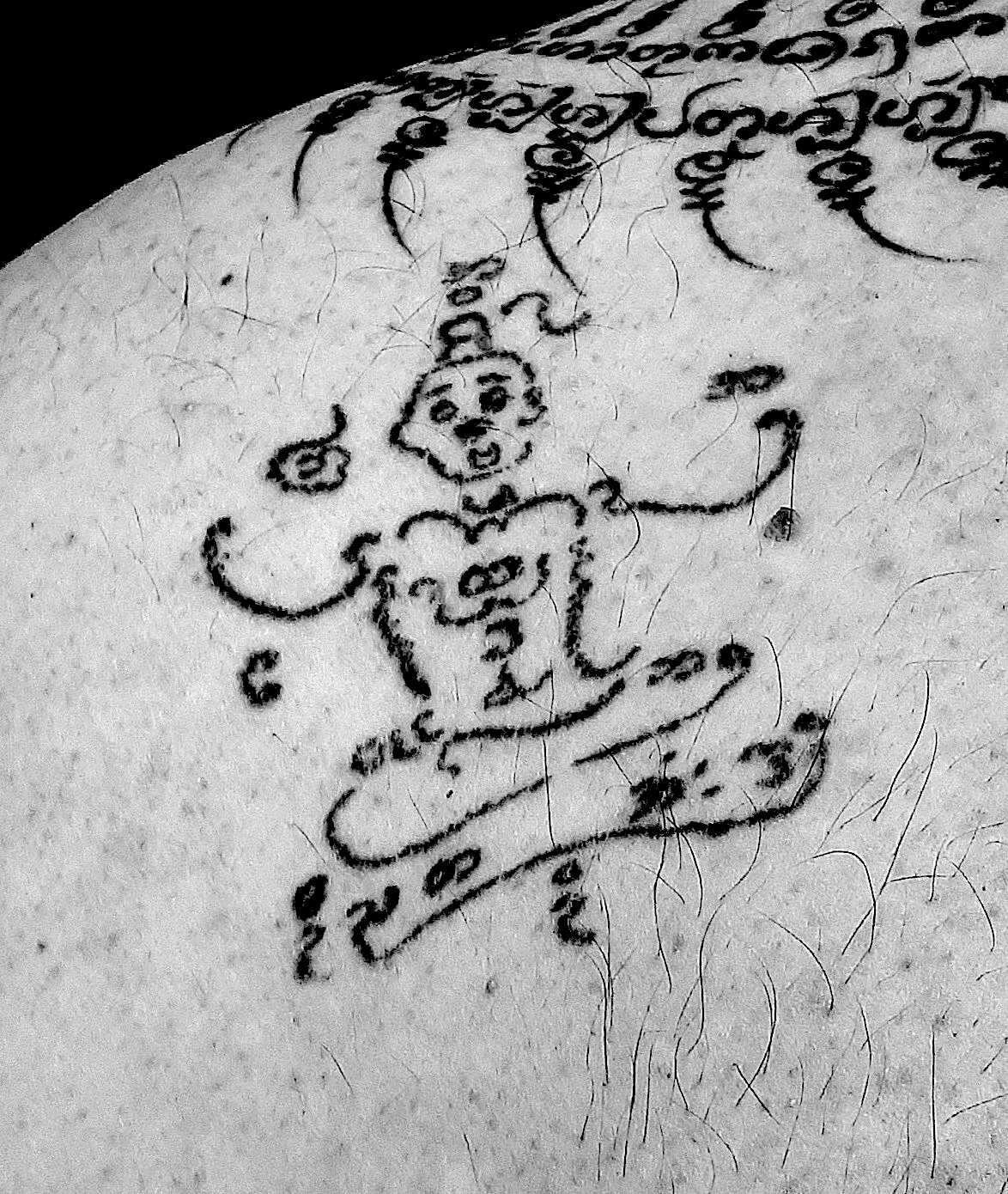
The Five Precepts, which I will list further on, are the basic code of ethics to be respected by devotees of Buddhism. Upholding these five rules of personal conduct I see as part of the daily practice for me, which in turn strengthens and powers the Sak Yant designs upon my body. Do not trust anyone that tries to suggest that the blessings and elements of Buddhism can be side stepped or dropped from the application of Sak Yant. It is a crucial element regarding the consecration of these sacred and sophisticated forms of Buddhist and animist magick. Jing Jok (gecko or lizard) Sak Yants fascinate me. I received Jing Jok Sak Yants from Ajarn Apichai who had just completed seven years of training surrounding the wicha (knowledge) of this very unusual and particular form of Sak Yant. In the canon there are an original nine Jing Jok designs which then evolve into a further 108 different designs and permutations. Each design has a specific functionality and magickal purpose. The tattooing of animals in Thailand is seen as a magickal way of capturing and embodying the very characteristics of that animal or creature. Jing Joks are flexible and highly adaptive creatures that can live in almost any environment successfully. They can go so far as to camouflage themselves completely by changing their colour, and can evade almost any danger, even if it means regrowing their own tail after a close escape.
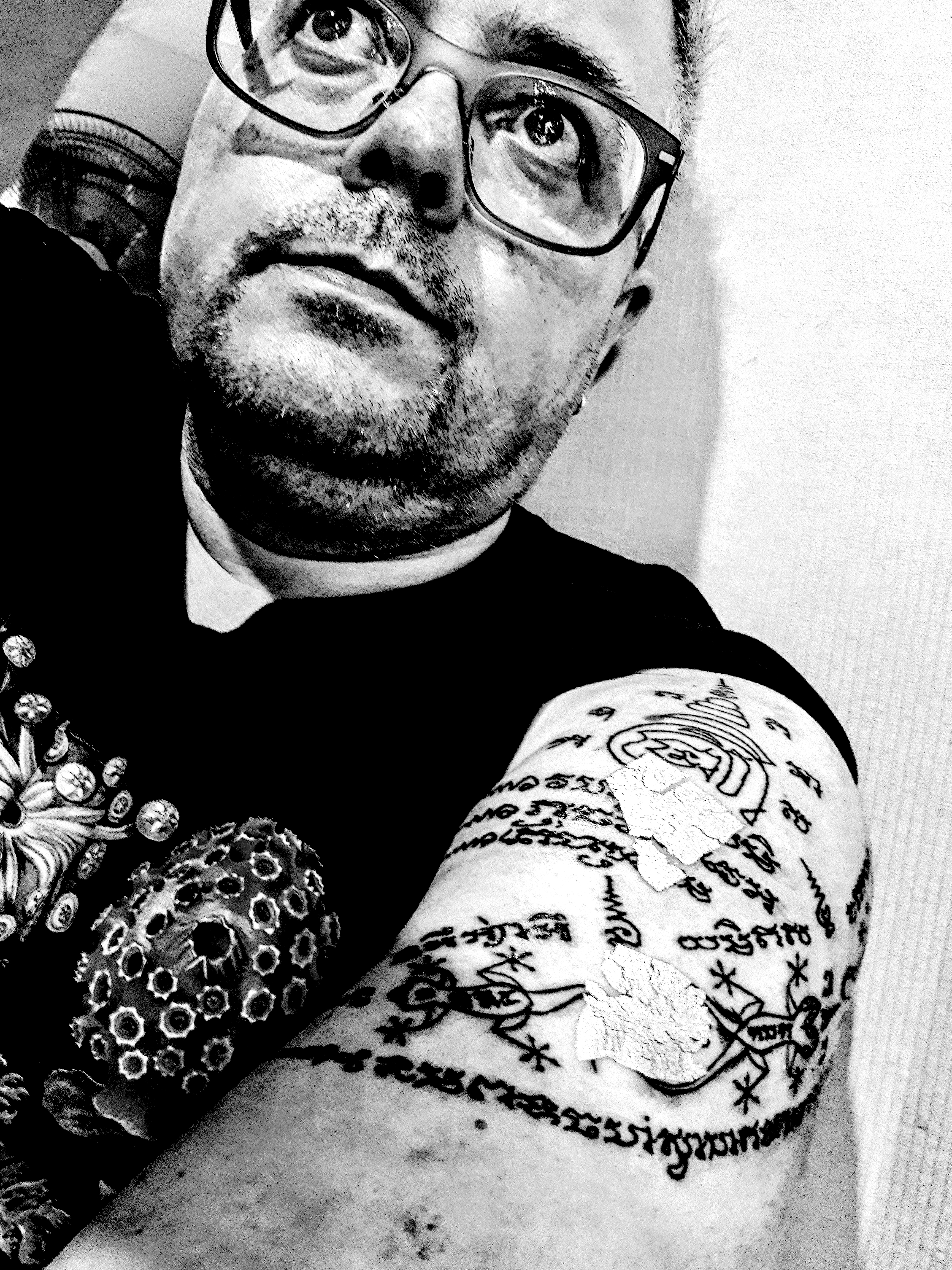
These qualities are very much admired and revered by Thai people. The folklore of people in Thailand has evolved to believe that Jing Joks (geckos) bring charm, good fortune, and luck. After finishing off the three beautiful and perfect Jing Joks, Ajarn Apichai added a Buddhist Heart Khatha Yant and three single lines of Khom script underneath. The ritual was then finished off with chanting, the blessing of gold leaf being placed onto my upper arm and then blessed water infused with Sompoi (Senegalia rugata). This spiny climbing shrub native to China and tropical South-East Asia and is used in the Indian subcontinent and is one of the ancient Ayurvedic medicinal plants. It is believed that Sompoi extracts, which contain significant levels of antioxidants, help to protect cells from damage caused by free radicals and is used as a sacred form of cleansing agent in blessings. The blessing of Sak Yant tattoos therefore using Sompoi is in of itself an act of spiritual, medicinal and magickal of protection.
Beyond the spirits, magickal spells and psyche transforming qualities that dwell inside these extremely beautiful, detail orientated and powerful designs there also lies the healing and dissolution of trauma. In her article Tattoos After Trauma: 6 Qualities of Healing Potential by Suzanne B. Phillips, Psy.D., ABPP she discusses potentially six healing qualities that are associated with tattoos; remembering and mourning, body as a healing canvas and gallery, the re-defining of self through body modification, the narration of healing through words and images, undoing the shame of hidden trauma and fostering connection with the self, others and the future. While I wholeheartedly agree with Suzanne I would also like to add that a solid daily spiritual practice, irrespective of your denomination and leanings, would also strengthen and bolster any form of magickal body modification. There are many different rules of abstention for Sak Yant tattoos which are all dependant on which particular master and their specific lineage has delivered the Sak Yant onto your body. For example, my teacher Ajarn Daeng makes express wishes for devotees not to eat dog meat whatsoever. Monks have a remarkable 227 precepts which to uphold on a daily basis. I personally find attempting to hold just the Five Precepts are more than enough to successfully manage day to day, which are a means of building character and laying the ground work towards having good karma. It is also important not to boast of having supernatural powers or make special claims of having protective powers because of your Sak Yant or amulets despite any evidence showing otherwise. A consistent and honest daily practice (chanting, meditation, making offerings, performing rituals and studying Buddhist sutras) incrementally strengthens, fortifies and empowers many wearers of Sak Yant. There are now Sak Yant wearers in countless professions, including Martial Artists, UFC Fighters and Muay Thai fighters who train in Thailand and often end up with Sak Yant.
The idea of Buddhism being simply just a “teaching of images” (xiang jiao) evolved in the second century from the catalysing contact of Mahayana teachings, statues etc. in China. Chinese Buddhism attempted to particularise and separate Buddhism from its own indigenous Daoist and Confucian philosophy during its initial absorption. In Thailand’s distant past Thai officials would mark the wrists of their subjects in order to record and compile statistics surrounding male workers. It is assumed that the marking of the body using tattoos may have occurred since the early Ayutthaya period during the reign of King Borommatrailokkanat (1448–1488). At one point it was hypothesised that the various yantra used were in fact invented by a Tantric sect originating in Tibet (a branch of Mahayana Buddhism) and that these yantra were then taught in Burma before being introduced to Thailand. In the Northern Thai kingdom of Lanna leg tattooing denotes the transitional rite from adolescence to manhood. Leg tattooing goes from the knee up to the waist. It’s called Sak Tiew Kha Kom which means the tattoo once finished will be like wearing a form of shorts. It is believed it will bring good fortune, safety, and protection from danger. The test of endurance and how one reacts under pain while acquiring Sak Yant, calmly or otherwise, is an important part of the hallmark of initiation during the ritual of receiving. If one shows calm and fortitude, the preferred state a devotee should exhibit while receiving Sak Yant, then one is called “wooden” by the teacher, as I was during the ritual pertaining to the Yant Soi Sangwan, the Sak Yant diagnosed for me by an Ajarn. This 3 layered Sak Yant design of Buddhist scripture has the magickal benefits of giving the wearer the virtues of great mercy, great power, prestige, avoiding danger and being invulnerable to any sharp objects. It is the Sak Yant of spiritual warriors. Having blood tests after receiving this very unique form of Sak Yant however did become a somewhat laborious task for me. Nurses often have to treat me like a pin cushion, repeatedly digging needles into my arms trying to obtain blood samples.
In these shocking, difficult and very testing times for the citizens, sangha and lay people in Thailand, which witness daily many various high profile monks and Ajarns becoming “defeated”, either falling foul to the vagaries of perpetrating sexual assault, drug addiction or the dark and vile manipulations that certain well known sorcerers are prone to when they think that their position in society is one of invincibility, it is always wise to go back to the basics when in times of chaos or turbulent confusion. The Four Pārājikas (or the four “defeats” found in the Buddhist Monastic Code 1, Chapter 4: Parajika. Copyright © 1994, 2007 Thanissaro Bhikkhu Access to Insight edition © 2007) are the four specific rules, if broken, which entail a life time expulsion from the sangha for any monk that breaks them. These rules are the non-negotiable rules of abstinence from sexual intercourse, killing or the taking of any human life, stealing (anything worth more than one 24th troy ounce of gold which to be honest is a chunk of change considering the rising price of gold these days) and lying. It is always for me a grounding experience to go back to the basics in the first instance, and then, after personal reflection, step forward once again after some form of personal crisis of ethical greyness. Sak Yant ultimately can teach us that you get of out them exactly what you put into them and that what you put into them is indeed completely dependent on your daily practice, perseverance and personal ethical and moral conduct. For Ajarns, lay people and devotees The Five Precepts in Buddhism is a practical framework which the Buddha established five moral precepts (pañca-sīla). These are often interpreted as five foundational virtues. He repeatedly stated to his disciples to:
- Abstain from taking life
- Abstain from taking what is not given
- Abstain from sexual misconduct
- Abstain from false speech
- Abstain from intoxicants that lead to heedlessness
These precepts are, in essence, the living embodiment of three factors from the Noble Eightfold Path: Right Action, Right Speech, and Right Livelihood. Crucially, they are formulated as precepts rather than commandments. The Buddha did not impose them as divine laws nor issue orders to be obeyed. Such external compulsion would be impossible; adherence must arise from an internal volition, a sincere desire to cultivate one’s own moral integrity. Initially, the precepts may appear straightforward, perhaps inviting a casual confidence like, “I can easily keep these.” Yet, when integrated deeply into practice over time, their profound difficulty reveals itself. Far from being mere prohibitions, they possess immense depth. They require not only the renunciation of unwholesome conduct but also the active cultivation of corresponding virtuous qualities. To this end, the Buddha offered a path structured around three interconnected trainings: morality (sīla), concentration (samādhi), and wisdom (paññā). These three practices mutually reinforce one another. It is through paññā that the practitioner comes to realize, through direct experience, the fundamental characteristics of existence: impermanence (anicca), unsatisfactoriness (dukkha), and non-self (anattā). Yet wisdom cannot arise in isolation; it requires a foundation. The mental clarity and stability necessary for genuine insight emerge from samādhi and sīla. These two pillars are so indispensable that the Buddha’s entire teaching is distilled in the Dhammapada (verse 183):
“To abandon evil, to cultivate good, to purify the mind—this is the teaching of all Buddhas.”
Chatral Rinpoche (Chatral Sangye Dorje), a legendary Tibetan Dzogchen master and reclusive Ngagpa (man or woman of mantra) yogi, in the book Compassionate Action, recalls the words in regard to losing one’s conduct from the master Guru Rinpoche (‘Precious Guru’), a legendary tantric Buddhist Vajra master from medieval India;
“In the direction of the view, if conduct gets lost, the view goes to the tarnished state of Mara. In the direction of conduct, if the view is lost, having become entangled by the hopes and fears of materialism and ideology, real liberation will never come and there is no way you can reach the level of the unified state.”
There are many countlessly strange and beautiful things in Thai Buddhism but possibly one of the strangest and most beautiful of all is in fact Thai Buddhism itself. My book Thai Tattoo Magick is published by Inner Traditions.
 Sheer Zed ~ Author • Buddhist Shaman • Musician