

I think that I shall never see
A poem lovely as a tree.
– Trees by Joyce Kilmer (1913).
The symbolism of the tree known as the Bodhi Tree in Buddhism represents a set of key values in the Buddhist faith, a sacred place where Siddhartha Gautama achieved his legendary enlightenment and wisdom. The definition of the word “enlightenment” is a misleading Western translation of the Buddhist terms Bodhi (to awaken or understand) and Vimitti (mokṣa, the release and freedom from fetters and hindrances). Mokṣa refers to “release from the bondage of the mundane life” according to the Purāṇas. The word “enlightenment” however is sadly a troubled child of poor decision making due to Max Müller’s 19th-century translations of Sanskrit and the society of that particular place in time pressurising for an over simplification of a multifold idea in order to neatly fit Western expectations of what they thought Buddhism was or could be into a neat little pigeon hole. Evan Thompson’s “Why I Am Not a Buddhist” argues against the notion that Buddhism is just merely a science of the mind, and that the essential metaphysical and ritual elements of traditional Buddhism have in fact been removed. I agree. My intense and gritty personal interface with the vast and diverse world of Thai Buddhism and the extreme rituals which I was exposed to revealed to me a far deeper and seemingly unending reality of ritualised behaviours that many over-priced coffee table books could never even being to capture or quantify. Müller’s shift in his translation of the Buddha himself from being “awakened” to “enlightened” is for me damaging and has very clearly caused a distinct narrowing of clarity and understanding. The shape and tone of written language as we all know can imperceptibly shift and warp the meaning of any underlying truth over time. Becoming “awakened” for example feels like it would take a considerable and decades length amount of time. However, becoming “enlightened” has the plugged in connotation of the instantaneous convenience of a smartphone app. Müller’s shift in translation focuses upon Western philosophical ideas and obsessions with the idea of individual self-discovery while losing the very important idea of the absence of a permanent self (anattā, the doctrine of “non-self” that no permanent self exists and the absence of essence in any phenomenon) which Buddhism expounds and discusses in considerable depth. While I do freely admit to my own use of the word “enlightenment” it is done so in the knowledge of its source, accepting its misleading, troubled and limiting history. Academics and practitioners who publish articles stating we will all eventually die, as if to reveal some new and unique form of wisdom, completely miss the fact that Buddhists and indeed Buddhism itself is hard wired for that observation. This is exemplified in a particular 4-fold explanation and interpretation of the word bodhi which I warm towards due to its inclusion of the important symbolism of the tree namely; 1. the tree of enlightenment 2. the holy path (The Noble Eightfold Path) 3. Nibbāna (the term in Sanskrit for the fires of the passions and of self-view “to be blown out”, “quenched” or “extinguished” and ultimately in a state of not becoming) and finally 4. the omniscience of the Buddha.

The Bodhi Tree is defined as the Ficus religiosa in various sources. The original tree was destroyed in the 7th century, however offshoots of the original tree are still to be found in Sri Lanka and India. The idea of the symbolism of trees has a long standing and a far deeper pre-existing legacy of considerable spiritual and magickal importance in Indian pre-Buddhist culture, which still has its place as an auspicious central point of spiritual life, meaningful resonance and a training ground for personal awakening. In the Sarhul (“worship of the Sal tree”) festival, one of the most revered festivals in Sarnaism, the worship of nature and the union of the Sun and the Earth is celebrated. Sarnaism is a faith originating in the Indian subcontinent followed by indigenous tribes. The festival lasts for three days, from the third day of the Chaitra month in Shukla Paksha to Chaitra Purnima. The Sarna in Sarnaism (whose core principles are jal (water), jaṅgal (forest) and jamīn (land)) is a sacred place, a grove of Sal trees. The Sarna is a remnant of forest which is part of the village, a place where spirits are thought to reside. Offerings are made during auspicious times such flowers, fruit, vermilion, a rooster, and liquor to the Sun, the village deity, and ancestors. In A. G. S. Kariyawasam’s fine 1996 work Buddhist Ceremonies and Rituals of Sri Lanka it states;
“The ritualistic worship of trees as abodes of tree deities (rukkha-devata) was widely prevalent in ancient India even before the advent of Buddhism. This is exemplified by the well-known case of Sujata’s offering of milk-rice to the Bodhisatta, who was seated under a banyan tree on the eve of his Enlightenment, in the belief that he was the deity living in that tree. By making offerings to these deities inhabiting trees the devotees expect various forms of help from them.”
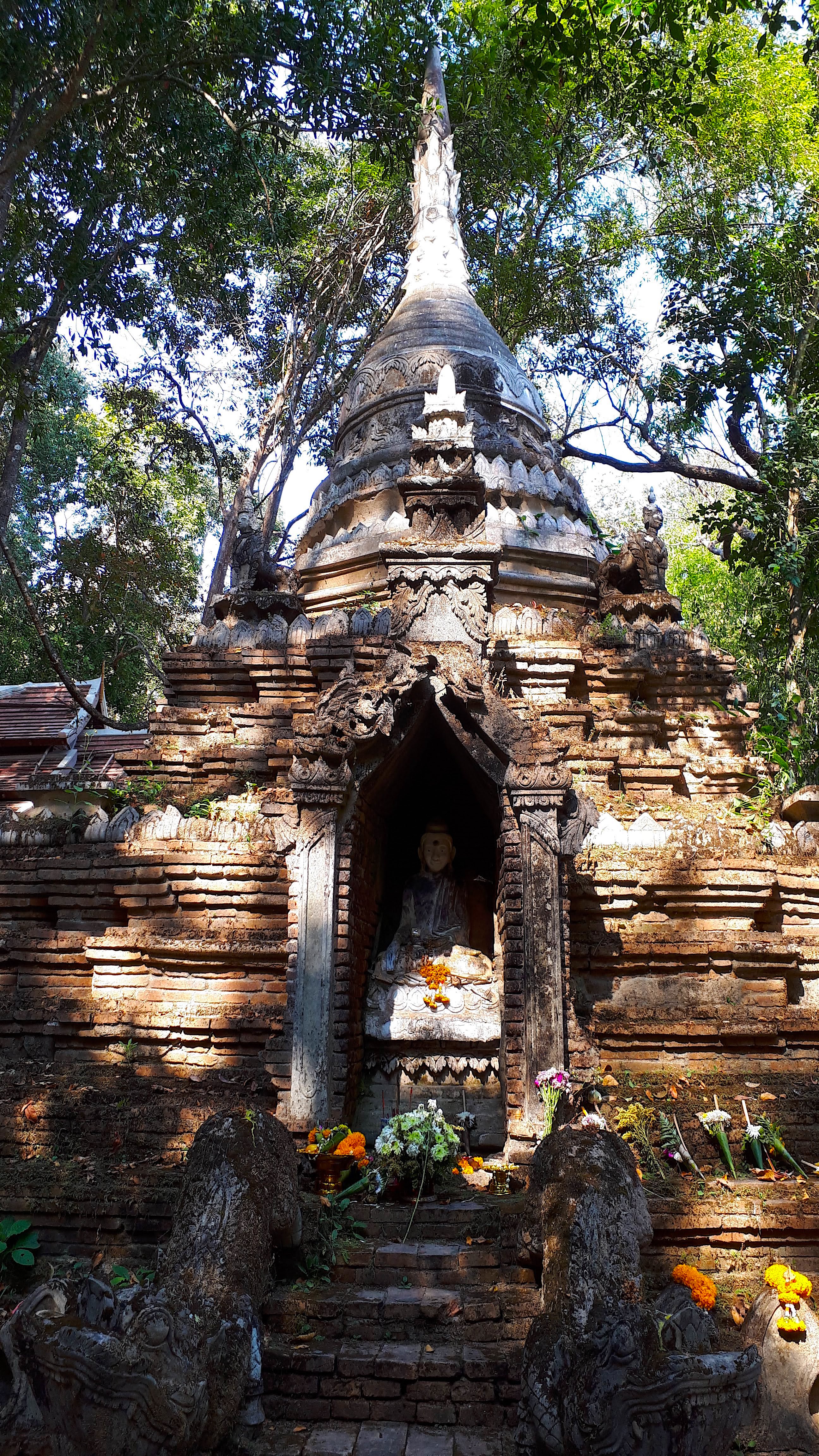
The tree ultimately can be seen as a totem of divine magick, a transcentral point of veneration, healing and transformation. During veneration in Buddhist practices it is praised with markings, ribbons, prayers, statues, pots of money and a complex variety of esoteric votive offerings which festoon this most treasured of ancient symbols. Trees of course have significant meaning in various spiritual traditions across the world and in many cases are viewed as sacred and divine entities that connect the earth to the heavens, to invisible spirits and mankind itself to these guardians of enduring presence and protection. In Buddhism the tree is directly connected to Buddha in not just one but various instances that underline its symbolic importance. The Buddha himself was born in a sacred grove of trees at Lumbini, his mother Queen Maya grasping onto a tree branch during his birth. Prince Siddhartha along with other spiritual ascetic practitioners performed acts of renunciation in a forest near Kapilavastu. He then resided in this forest as a practitioner himself. This event in Buddha’s life seeded the idea of monks abiding and travelling to and from and dwelling in forests. Today the Kammaṭṭhāna Forest Tradition of Thailand (the Thai Forest Tradition) is a lineage of Theravada Buddhist monasticism which started around 1900 with Ajahn Mun Bhuridatto, respectfully reflecting the ancient originating point of initiation. Buddha experienced spiritual awakening under a tree over the course of seven days. Buddha taught his first sermon in a forest at Sarnath. Then later at Kushinagar, a town in the Kushinagar district, Uttar Pradesh in India, Buddha is believed to have died and attained Parinibbana. After a journey from Pāvā, he delivered his last teachings to his disciples before passing away near a grove of sacred trees. The Mahāparinibbāṇa Sutta is a scripture concerning the end of Buddha’s life and is the longest sutta of the Pāli Canon. It’s the principal source of reference of the Buddha’s death.
The symbolism of the tree in Buddhism can be viewed therefore as being the very presence and embodiment of the Buddha. The tree, due to numerous synchronicities, various continuing spiritual significances and countless cross cultural serendipitous connections becomes synonymous with the Buddha himself. Interpretation of the tree and Buddha has given rise to a multitude of complex variants across cultures. In late 11th century Bagan, Myanmar a practice was initiated to observe the veneration of 28 Buddhas and the different corresponding Bodhi trees, as documented in a hagiographical Buddhist text the Buddhavaṃsa, which describes the life of Gautama Buddha and previous Buddhas and the trees they were associated with. It is said in an ancient text Buddha asked his disciple Ānanda, the primary attendant of the Buddha, to take a sapling from the Bodhi Tree and plant it at Jetavana Monastery so that whoever worships it would receive the same reward as they would by worshipping him. In the 3rd century BCE King Ashoka of India sent his daughter to Sri Lanka with a sapling from the right branch of the original Bodhi Tree for replanting. The tradition of taking a saplings from the original Bodhi Tree and replanting it was a founding ritual that was undertaken many times and reflects the seeding and spreading of Buddhism across Asia and the world. I was privileged to visit many Bodhi Trees on my pilgrimages to Thailand and marvelled at the diversity and intrinsic beauty of these sublime natural shrines of undying devotion and transformation. I view all trees as sacred and strongly encourage their worship, protection and veneration.
My book Thai Tattoo Magick is out now on Inner Traditions.
ॐ
 Sheer Zed ~ Author • Buddhist Shaman • Musician