
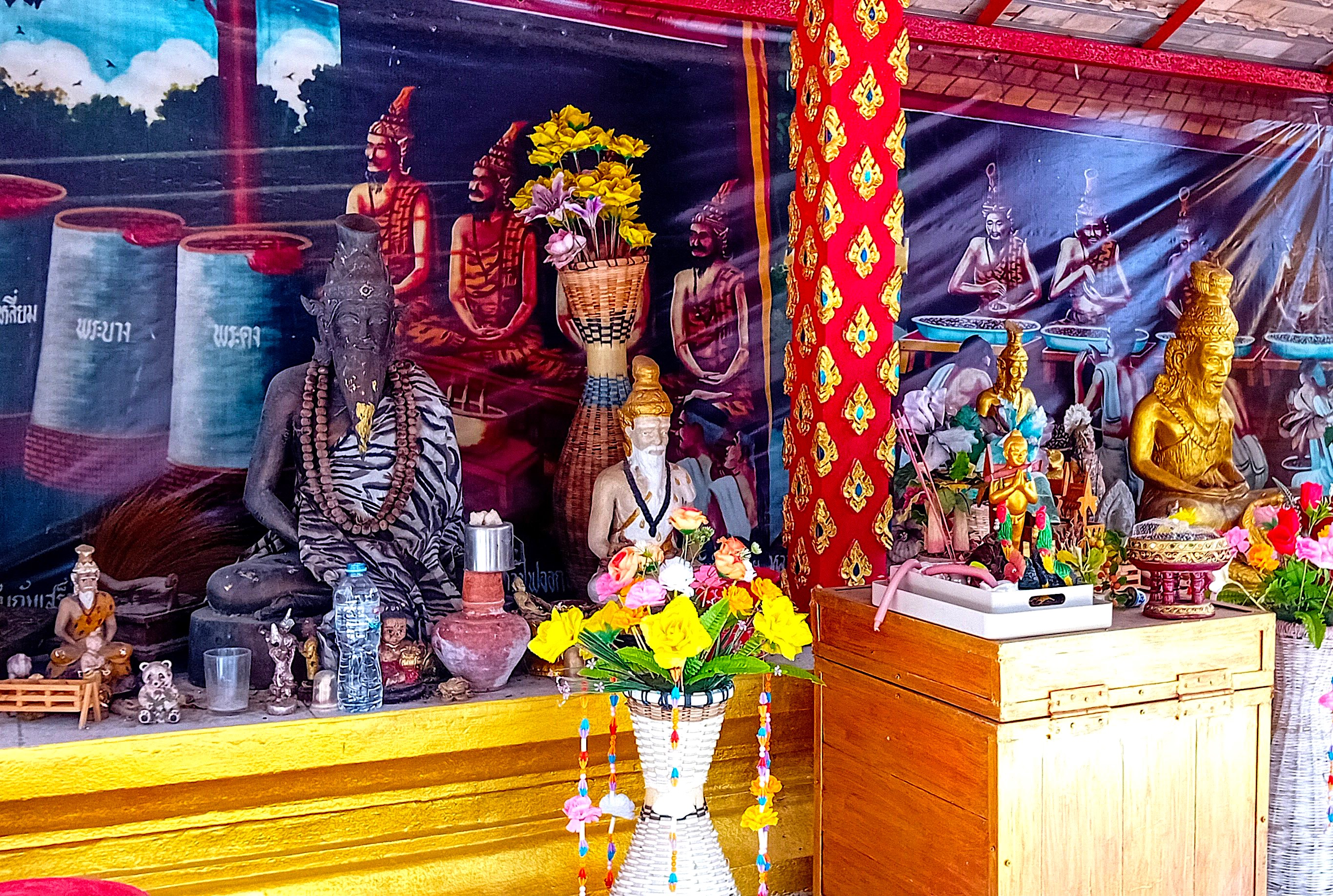
While the Phra Somdej amulet is known as “The King of Amulets” in Thailand the sweet, diminutive, quiet and enduring power of the Phra Khong amulet, made by the great master Phra Ajarn Amon, the abbot of Wat Phra Khong Ruesi, is the one that I often like to lean into when things either get tough, unexpectedly free fall or just randomly chaotic. Wat Phra Khong Ruesi was built in the era of Camadevi (662-669), the first monarch and Queen of Hariphunchai, a Mon kingdom, which was an ancient Kingdom in Northern Thailand. The city seamlessly mixes and combines the architecture and artistry of various influences. Legend has it that the Phra Khong amulet was originally created by Lersi (Ruesi or Ṛṣi), hermetic spiritual masters of various forms of transformative and esoteric magick, namely Lersi Vesuthep and Lersi Sukkhanta, two sublime and revered hermits in Thai Buddhism. It should be noted however, in Hinduism Lersi were in fact polymaths, people with an extraordinarily broad and comprehensive knowledge of many things. There are in fact 41 separate definitions of the term Lersi that spread across Buddhism, Pali, Hinduism, Sanskrit, Jainism, Prakrit, Marathi, Hindi, and Tamil. In the Puranic Encyclopaedia it states;
“In a sukta of the ninth mandala it is stated that the father of a Ṛṣi was a medical practitioner. There are references to many industries also…Ṛṣi wore animal skins but others wore dhotis and shawls… Weaving was a very important industry at that time. Cotton cloth and woollen blankets were made by them on a large scale. Iron was used by them with great skill. The manufacture of armours and the descriptions about them in Rgveda are ample evidence of the proficiency of the Aryas in ironmongery and blacksmithing.”
It is the Lersi’s legendary spiritual accomplishments that cut through the noise which surrounds these often misunderstood liminal and often sequestered beings, who, while hiding in plain sight, practice unimaginable acts of sublime high magick. Once again in the Puranic Encyclopaedia, Lersi (Ṛṣi) are endowed with remarkable instances of supernatural phenomena that accompany their undeniable and rock solid hermetic spiritual practices;
“A Ṛṣi dwelt in his a-‘rama on the banks of river Sarasvati. Owing to the blessing of Viṣṇu a son called Sumitra was born to him. As a result of his doing rigorous tapas for 1000 years he shone with a rare effulgence (a radiant brightness or brilliant splendour, often used to describe something that shines exceptionally or inspires awe). Though Viṣṇu appeared to him one day in the month of VaiSakha and asked him to choose any boon he wanted, he, who was so much detached in life, prayed only for devotion to God.” – Padma Purana, Uttara Khanda, Chapter 212.

Other renowned Thai Buddhist amulets come from Lamphun; Phra Perm referred to as a “Yot” amulet due to its classic shape with a Bodhi leaf halo, and not least the Phra Rod, re-discovered in the reign of King Chulalongkorn inside a collapsed stupa at Wat Mahawan in Lamphun province. This amulet was named Phra Rod because the Buddha image matched an ancient image of Buddha in the temple’s ubosot called Phra Rod Luang. During his reign, King Chulalongkorn (1868-1910), voted in 1999 as one of the “Most Influential Asians of the Century” for the 20th Century by Time Asia Magazine, also produced Phra Rod amulets. These were only awarded to selected individuals, enhancing their significance and value. These amulets are deemed as very powerful and are highly sought after by collectors and believers alike. The Phra Rod amulet is also known as the “escape amulet” treasured for its protective power to aid the wearer to “escape” any danger. It is said that the Phra Rod amulet was allegedly created by Lersi Narada, believed to be the first cosmic messenger upon the earth, for the citizens of the ancient Hariphunchai Kingdom to protect them during times of war. Phra Rod amulets are among the oldest and most revered in Thai Buddhism, dating back to the 8th-10th century. The Bhagavata Purana describes the story of Narada’s spiritual enlightenment and was seen as the primary source of information among the devas. The name “Narada,” however refers to many different people, and appears in many Hindu legends. Narada appears in the Jataka tales of Buddhism, as well as among names of medieval Buddhist scholars. In The Jakatas: Birth Stories of Bodhisatta by Sarah Shaw it states;
“…there lived an ascetic called Narada, who lived in the Golden Cave in the Himalayas and practiced the five higher knowledges. After seven days in the happiness of meditation he emerged from it and was exclaiming out loud, ‘O, the happiness, the happiness! I wonder if there is anyone in the whole of Jambudipa searching for this happiness?’”
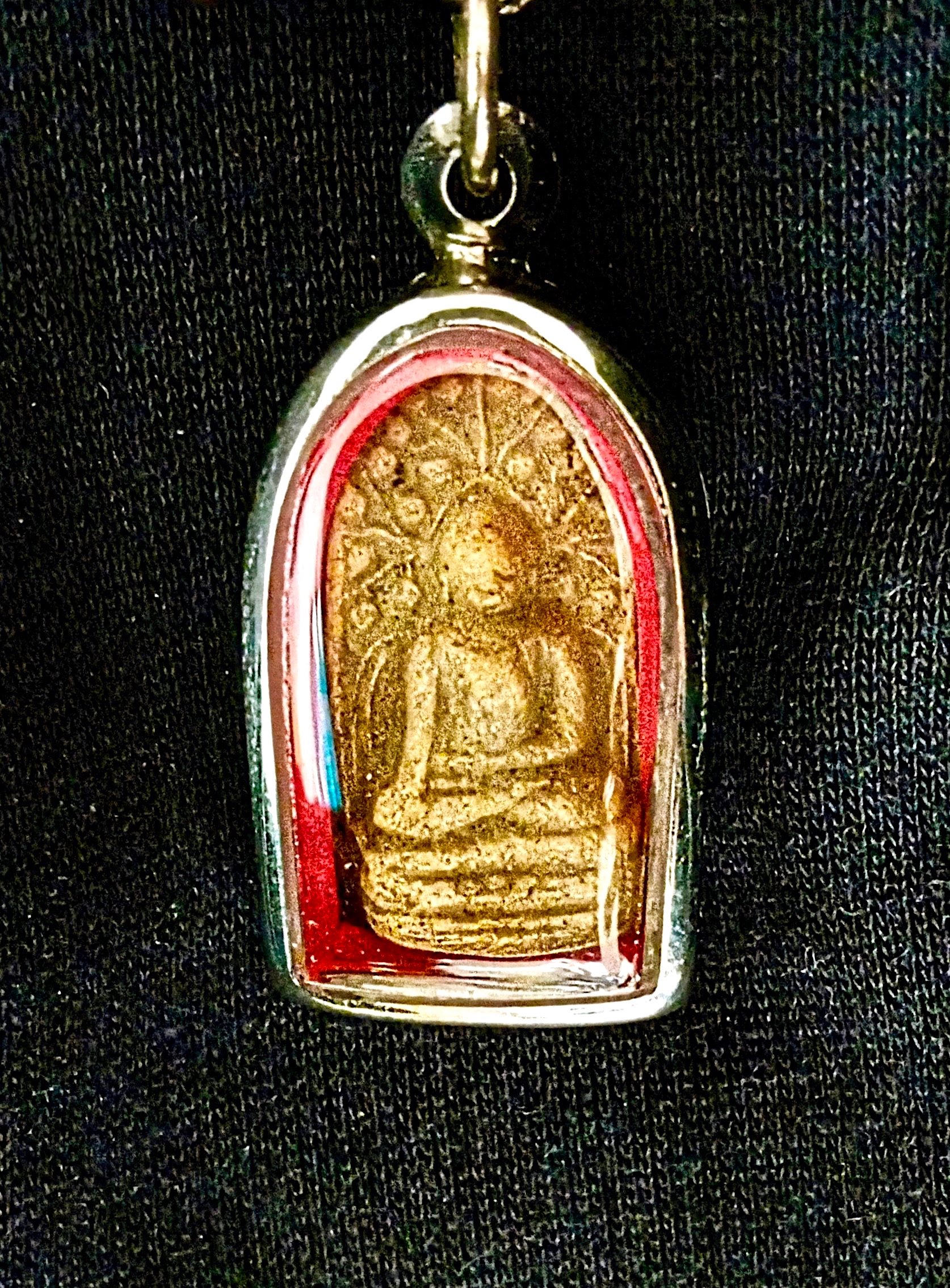
The baked clay Phra Khong amulet is however a very well-known and highly regarded sacred amulet in Thailand. It originated at Wat Phra Khong Ruesi which is one of four temples at the four corners of the city of Lamphun. The name of Wat Phra Khong Ruesi reflects the long and enduring association and ancient lineage of these great spiritual practitioners. The amulet’s magickal functionality includes invulnerability, granting kong krapan (immunity against weapons and harm) protecting the wearer from all forms of danger and misfortune, charm, protection, loving kindness, changing bad luck to good and an image of Buddha’s enlightenment under the Bodhi Tree make this a perfect amulet for any day that forces one to ride a crazy train of unexpected events and uncertainty. The form that the seated Buddha takes in the Phra Khong amulet is of a diamond meditation posture, also known as the Mara-Vijaya, Vajrasana or Thunderbolt pose, which involves kneeling with your feet together beneath your buttocks. This pose is beneficial for meditation, improving posture, and aiding digestion. This image is very likely influenced by Bagan Buddha images, which in turn were influenced by Indian art with the Lotus base. Buddha seated on a lotus base symbolises purity and enlightenment, representing the idea that, like the lotus flower that rises from muddy waters, one can achieve spiritual growth and clarity. The twenty leaves of the Bodhi tree speckled across an umbrella arch setting and a background halo indicate and symbolise both fertility and inner peace. Warriors, soldiers and those working in dangerous professions and people working in all walks of life often comment on the consistently positive effects of this most cherished of Thai amulets. I have personally experienced on occasion a literal magick carpet ride of kindness from the most unexpected of places when wearing this delightful and powerful amulet for which I’m very grateful indeed. It never ceases to surprise me.
In closing something needs to be stated here in regard to amulets and their makers. It is just simply this; the efficacy and spiritual power of any amulet is directly tied to the maker’s ethical, moral, and personal character and behaviour and the integrity with which they conduct their daily life in terms of Buddhist values. Amulets are reflections of the intent of their makers and carry a charge of that maker’s essence. The commitment to protect the values of the sangha is at the central core of any enduring and effective Buddhist magickal amulet. The sangha was originally established by Gautama Buddha in the fifth century BCE, offering a disciplined path for full-time practitioners, preserving Buddha’s sacred teachings, supporting the surrounding lay community and ensuring the integrity and dissemination of Buddhist doctrine. Any Buddhist magick amulet is only as strong and worthy as its maker’s energy and commitment to leading a spiritual life that is truly authentic and without defilements. In light of viewing the recent developments of various Buddhist monks and Ajarns falling from grace with public disrobing or unpleasant revelations regarding their personal conduct, this basic and pertinent point needs to be made and reiterated upon. Self-Reflection, mindfulness, maintaining integrity in daily life and acting with kindness and understanding towards others helps to foster an environment of integrity and trust.
My book Thai Tattoo Magick is published by Inner Traditions and is available at most booksellers.
ॐ
 Sheer Zed ~ Author • Buddhist Shaman • Musician