
I just keep hearing your footsteps on the stairs
When I know there’s no one there
Everyday, I love you more
So much more than the day before –
There’s A Ghost In My House by Holland, Dozier, Holland, and R. Dean Taylor (1967).
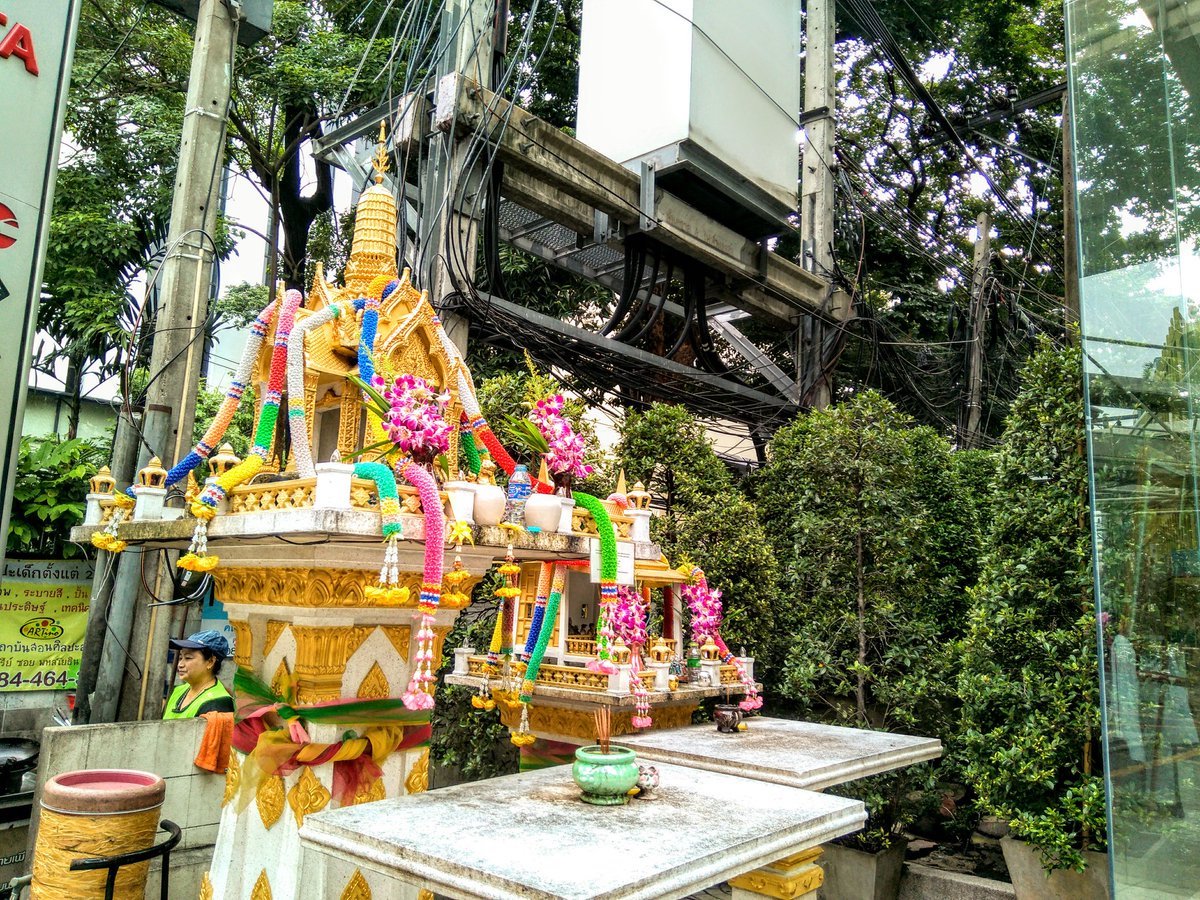
In 2017 I began a series three of pilgrimages to Thailand. Little did I suspect that these spiritual journeys into the rich and fascinating world of Thailand would completely and utterly change me both internally and externally and the way I would ultimately view life. During my first pilgrimage I was fortunate enough to stay in the Ari District of Bangkok. After some considerable acclimatisation to the intense and thick subtropical heat I decided to tentatively venture and explore the environs of where I was staying. It was during this time that I experienced my first encounter with a San Phra Phum, or ‘House of the Guardian Spirit’. It was located in an auspicious place (strangely near an electricity transformer) directly outside a Toyota Car Dealership at 362 Phahonyothin Rd. I fell in awe with this beautifully constructed shrine which was laden with a selection of various offerings.
A spirit house is a shrine dedicated to the protective spirit of any specific place within any location. Spirit houses are found across the Southeast Asian cultures of Burma, Cambodia, Laos, Thailand, Malaysia, Indonesia, Vietnam, and the Philippines. They provide shelter for the spirits that could possibly cause problems if not appeased. This is an integral part of their animistic belief system. Travelling up to Chiang Mai I experienced repeated encounters with these enigmatic and charming residences which at each and every point and turn were as different and varied as the last one I beheld. These domiciles for spirits are human built structures which offer an elegant rehousing alternative. Ghost-friendly offerings to spirit houses are made every day or on every Buddhist holy day and can include flower garlands, candles, bananas, oranges, grapes, rice, coconuts, incense, desserts and the obligatory strawberry-flavoured (red) Fanta which has been stated is reminiscent of the earlier practice of animal sacrifice, or it is quite possibly related to the practice of anchoring red incense sticks in a glass of water which promptly tints the water red. The streets of Bangkok are littered with dozens of opened, unconsumed Fanta bottles in unusual locations. In his seminal 1912 work The Elementary Forms of Religious Life French sociologist Émile Durkheim argues that religious beliefs are templates for and reflections of social structure; “Everyone readily grants that man has an interest in knowing the world around him, and that consequently his thoughts were quickly applied to it. The assistance of things with which he had immediate contact was so crucial that he had to try and understand their nature. But if, as naturism claims, religious thought was born from these reflections, it is incomprehensible that it could have survived these first attempts and persisted as it did. We need to know things so as to act in a way that is appropriate to them.” Therefore it can be then said that spirits in Thai culture exist in a type of social hierarchy mirroring its society as discussed in Ramitanon Chalartchai’s paper Spirit Lords [phi jao nai] (1984).

Mankind’s unrelenting drive to destroy nature and untouched sacred places has wrought upon the earth nothing but chaos, darkness, and insanity in my mind. My sincere admiration for the cultures of Southeast Asian countries and their deep respect for unseen land spirits is exemplified by the practice of building, worshipping at, and making offerings to these enchanting spirit houses. It’s believed that appeasing the spirits facilitates happiness, prosperity, and a peaceful life. It is an ancient practice that is widely and regularly performed. Stopping at a petrol station, which was for all intents and purposes in the middle of nowhere, I found yet another example built at the forefront of the forecourt. Spirit Houses are a part of everyday life. In Thailand there exists a social hierarchy of one hundred ghosts. Their status is determined by their power and virtue. The Guardian Spirit or Phra Phum Chao Thi is an example of this. Phra Phum Chao Thi is not purely just a ghost, and a house owner treats them with great respect by building a separate mansion for them. A spirit house is topped with a prang (spire). Inside Phra Chai Mongkol, an angel-like figurine that resembles a Hindu deity and protector, holds a sword in one hand and a bag of money in the other.
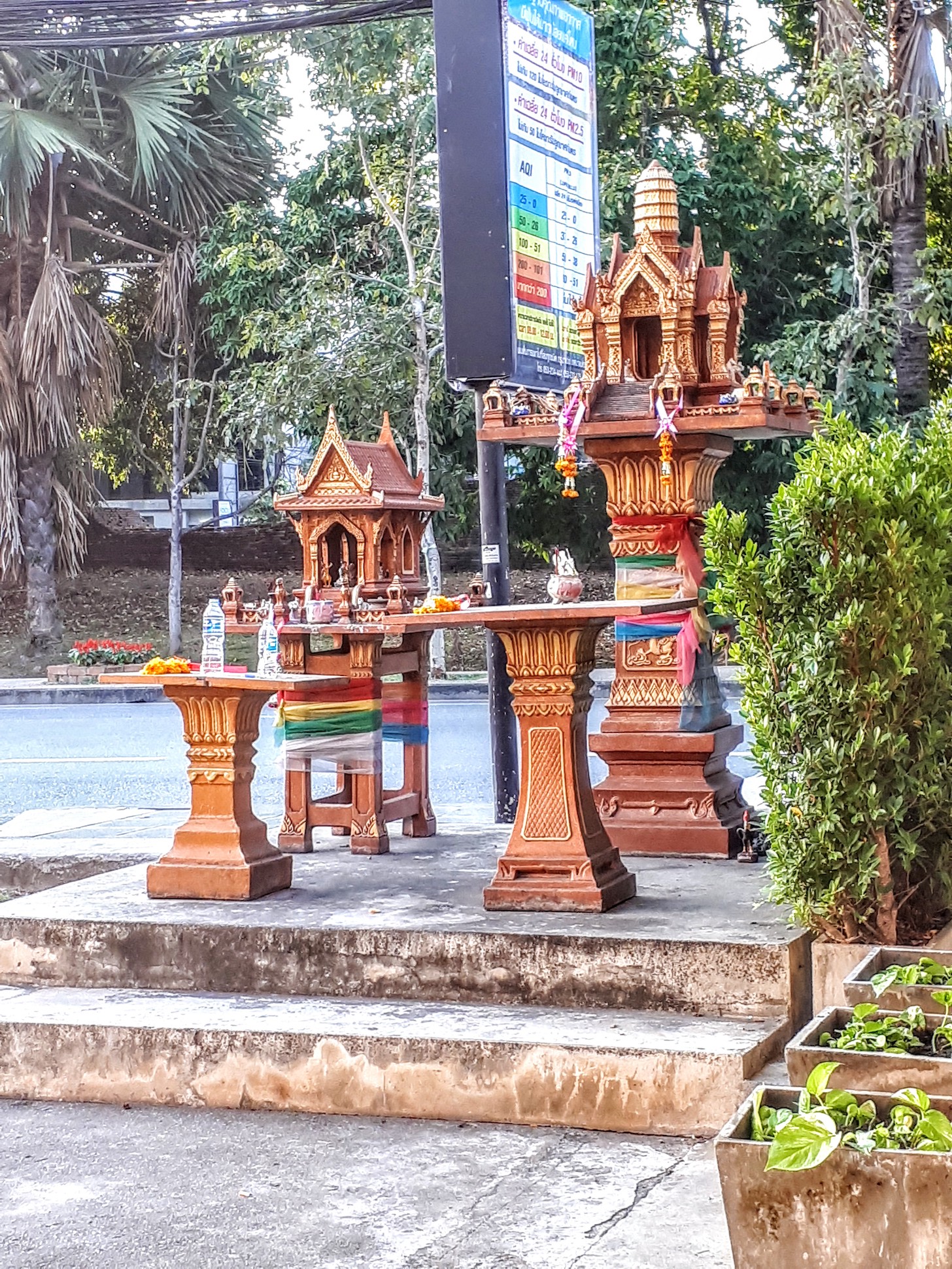
Ordinary household ghosts or Phi Barn Ruen do not have their own home and live within the home owner’s own residence. Mae Ya Narng, the Goddess of Vehicles, is also treated with respect and can have considerably elaborate rituals attached to the blessing of cars. Spirit houses in Thailand fall into two categories; a single pillared San Phra Phum shrine (for the Guardian Spirit) and a four pillared San Chao Thi shrine (for more tutelary deities which can also include the figurines of an elderly man and woman (Da and Yai or grandfather and grandmother) which represent the spirits of the ancestors). As you can imagine a considerable amount of time and planning is spent dedicated in the creation of these shrines. Brahmin priests, Ajarns, and monks are consulted like a form of spiritual design consultant in the preparations, design, and construction of these spirit houses. They determine the spirit house’s location, calculate, and triangulate the most auspicious day and time for installation using astrological tables and also any colours to be used to decorate it. Before construction commences the spirits are contacted through a series of rituals to directly communicate with them in order to seek permission for the use of the land. In an act of foundational acquiesce a pit is dug and the homeowners place inside it money, amulets, pieces of metal and a variety of colourful stones which are deemed to create a positive and welcoming energy field for the foundations. Finally a ritual is performed inviting the guardian spirit into their new dwelling. While I was doing my laundry early one morning in an outdoor launderette in Chiang Mai in the warm mellow sunshine I felt that their spirit house added a depth of serenity to an otherwise boring chore.
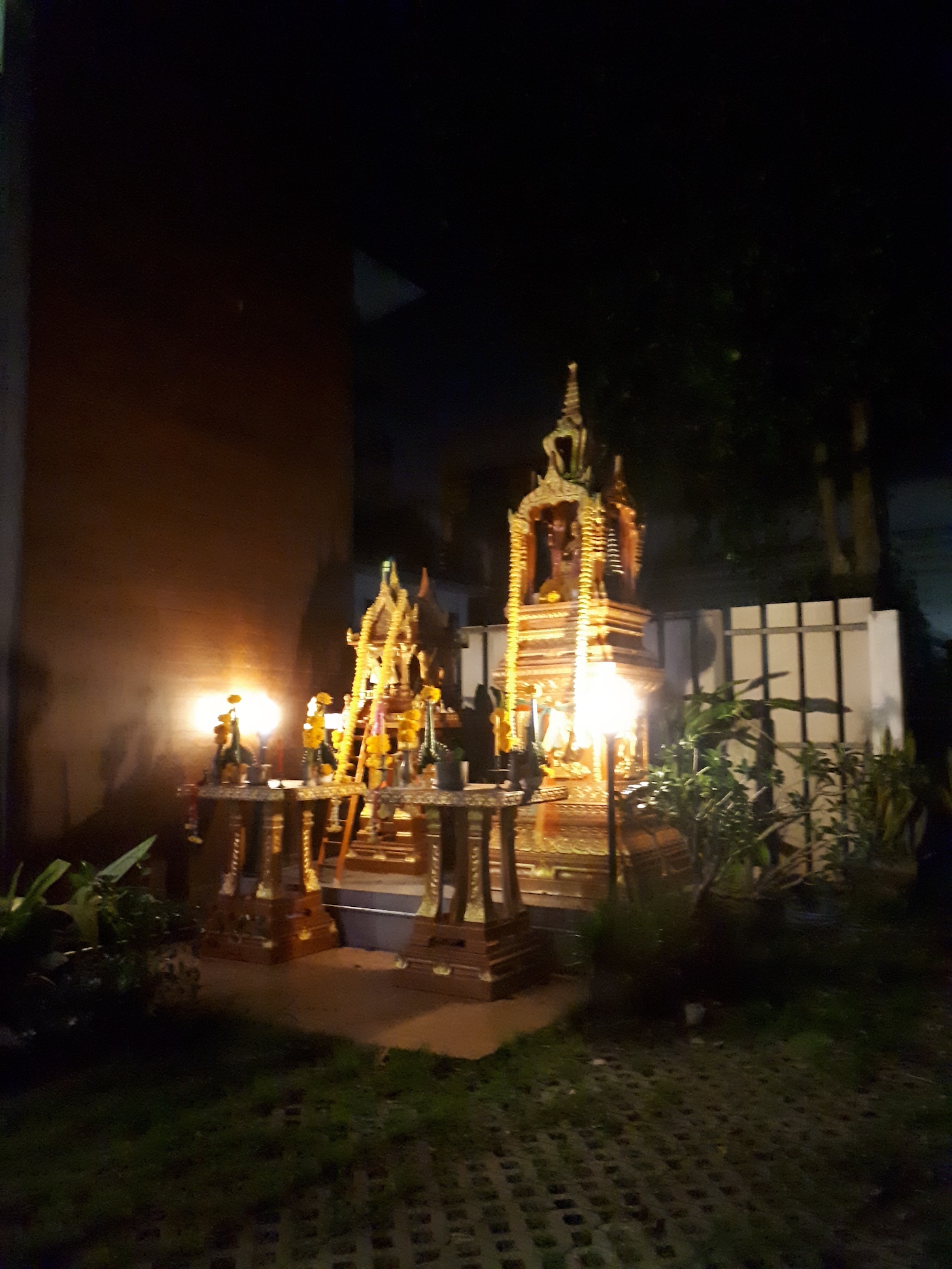
Spirit houses can also bring serious protection to properties if the inhabitants or caretakers therein are fed regularly and treated well. Reports of abrupt departures of would-be thieves leaving their abandoned tools and ghost keys still in the front door lock are not uncommon. Spirit houses on occasion though rarely have been used as points of strategic attack during riots and civil unrest. The Phra Phum Chao Shrine at the Royal Thai Police headquarters in Bangkok was splashed with paint of various colours during the People’s Party retaliation against the police, expressing their anger and dissatisfaction with the early dispersal of a rally in which many people were injured. Spirit houses sometimes can be lightning touchstones of hidden and unseen power at various unforeseeable times. The moving of spirits houses can also present serious consequences if not approached in the most careful of methods as discussed in Audrey Taylor Gonzalez’s post Spirit Houses Give Pause; “A major issue is what if the owner moves. Moving a spirit house is to be avoided and it could be bad for health if the owner tries to do away with the house. New landowners leave an old spirit house intact and build a new one alongside it. If it must die, an auspicious ceremony needs to happen with a Brahmin priest or Buddhist monk. Then a spirit house makes its funeral march to its final resting place at a designated and blessed spirit house graveyard. It’s best if near a Banyan tree. If in death it does not rest in peace, the landowner is doomed to find no peace in his life.” There was one particular breakfast place around the corner of my hotel in Chiang Mai which sadly no longer exists since the pandemic fanned out its vast and all-encompassing cloak of death. This breakfast café made the best omelettes. I would sit near their spirit houses while having breakfast and quietly chat with the occupants. This daily ritual was one of the pleasures I loved to undertake while I was on pilgrimage. Checking Google maps I saw with sadness that the breakfast place had vanished. However, the spirit houses remained, untouched and still resplendent with fresh offerings. This is for me a solid testament to the strength and enduring quality of devotion to the land spirits and deities in Thai culture. Whilst everything may or may not disappear the spirit houses of Thailand continue to remain, their invisible transcendent inhabitants hanging out in opulently sublime cribs, while still swirling gloriously in the vast landscape. Like the birds, bees, and all manner of nesting creatures in nature land spirits require our utmost respect and regular praises to ensure an unmolested life journey.

Scepticism of the ritualistic practices that surround the building and worship of spirit houses or indeed any form of religious or spiritual activity is to be expected by those either on the outside or any casual individuals who may find a juvenile pleasure in doing so. I have on occasion caught sight of myself and asked sincerely whether my adherence to my daily practice is actually essential or indeed really necessary. This question continues to remain unanswered since I find that my daily practice, which includes writing, meditation, making offerings to deities and spirits, chanting, working with amulets and practising necromancy, is engaging to the point of complete fulfilment and total immersion. You get out of it what you put into it. The multi-faceted system of Thai Buddhism, which is in itself a complex, unending, and very highly inclusive form of countless other forms, has become a permanent and much-loved part of my own personal internal dōjō. It has quite simply changed my life. I sincerely hope that this blog in some small way has opened you up to the possibility of gently questioning that which you think you see is indeed what is actually there. For if we cannot directly see something it does not mean that it is not there. In science atoms observed often change their behaviour. Invisible realms and worlds are indeed within and outside of us. The magnificent spirit houses of Thailand are profound and beautiful personifications of this intriguing possibility and still continue to be a regular and welcome part of the Southeast Asian landscape. If you take care of the land spirits, they will take care of you.
A shorter version of this recently expanded post originally appeared on the 15th of October 2022 on the website Superstition Sam in the guest blog section.
 Sheer Zed ~ Author • Buddhist Shaman • Musician