
Do I contradict myself? Very well then I contradict myself, (I am large, I contain multitudes.)
– Song of Myself by Walt Whitman.
Spirit and demon possession is the control of the human body by spirits, ghosts, demons, or gods and exists in many religions and traditions. Sergei Shirokogoroff, Russian anthropologist (1887-1939) lists five essential characteristics of a shaman (at least among the Tungus of Siberia): 1. A shaman is a master of spirits, who has 2. Mastered a group of spirits; 3. A shaman commands a recognized array of techniques and paraphernalia that have been transmitted from elders; 4. S/he possesses a theoretical justification for the shamanistic process; 5. The shaman occupies a special social position. In Shirokogoroff’s 1935 work Psychomental Complex of the Tungus 1 he further goes on to discuss the issues of possession and how spirits are perceived to be absorbed into the human body; “Self-introduction of spirits into the persons awake or asleep is a common phenomenon among the Tungus. Indeed, in both cases the self-introduction of spirits is based upon the form conviction of the Tungus that 1. The spirits exist; 2. the spirit may enter the body: 3. the spirit may act when introduced.” The issues that run through all systems of religious and philosophic thought is how these spirits, whether they be good, bad, or more nuanced and complex in their stance, are managed daily/monthly through ritual and in the most extreme of cases, exorcised from the body. Christianity, Buddhism, Haitian Vodou, Wicca, Hinduism, Islam, and Southeast Asian and African traditions all have a very specific and unique take on how, why and if this difficult and dangerous procedure is to be accomplished. My own family I was to observe had its own brush with possession, though from so called normal societal values and processes, my father was deemed to be very much under the condition of being mentally ill. My mother once told me about something my father had undertaken while he was on National Service in the 1950s when he was based in Germany though she fully refutes ever saying this to me now, which I find puzzling and most peculiar. Maybe she felt that the apple doesn’t fall far from the tree and didn’t wish to encourage or validate my inquisitiveness in anyway whatsoever. She’d told me that my father had confessed to her that he had performed a “black magic ritual in the Black Forest”. I gathered that he had drawn demons into himself using a magic circle and the correct incantations. Once while attempting to have an extremely rare father and son evening in central London in the mid 1990s, he’d left me standing by a concrete chess table under a pagoda like folly in the centre of Chinatown, while he drunkenly sought out an old Kray Twins dive for us to have a drink at that he’d used to frequent in the 1960s when he was manager of a large betting shop. An hour passed. I knew that he’d deliberately left me there standing alone in an act of cruelty and spitefulness. Before the hour had fully passed a huge gust of wind pushed past me a tabloid newspaper along the cobbled street floor. The hand of totality personified itself for a moment in the very wind itself, fanning and flicking open the pages before me on the floor to a large bullet point headline inside which read; “I Lost Him to Cruel Demons That Lay Lurking in His Soul.”
It was at that eschatonic point that I knew my father, astrologer, gambler, computer programmer and magician was indeed possessed by some unidentifiable demons and that he had summoned into himself while serving his tour of duty in Germany. The fact that he was diagnosed as clinically depressed in 1972 and a fully blown schizophrenic who had attempted to kill me during a psychotic rage when I was at the tender age of four didn’t help matters much. Medically speaking Schizophrenia is closely connected to dysfunction within the temporoparietal junction, causing various issues resulting in ghostly visions and out-of-body experiences, which I personally have experienced throughout my life. Shamanism, for all intents and purposes has, despite having a dissolved sense of self and an initial crisis of the psyche, has helped to establish and formalise within me a sense of being through continued ritualisations, initiations and re-integration into the community. I am/we are not in any way whatsoever special. I am/we are just specialists. Poet Rainer Maria Rilke refused treatment for his visions, saying “don’t take my devils away, because my angels may flee, too.” Shamans dealing with any form of possession are probably the best placed to do so due to their inherent metamagical abilities to identify, solve problems and begin transformational healing. Tragically a neighbour I’d been supplying care for very sadly passed away recently. As human beings we all have peccadilloes and proclivities that can be very challenging. Margaret was a singular person that had a very strong personality who suffered greatly. I witnessed on at least one occasion a form of possession taking place that spread across her face in a dark and grim mask. This poor elderly lady had been abandoned by her family and as a surrogate both myself, my mother and another neighbour spent five years caring for this grandmother of four children all of them mostly absent or unwilling, Anne cleaning, laundering, and escorting her to appointments, myself and my mother doing a variety of volunteer care work of numerous different kinds. One Halloween a couple of years back she wished to dress up as a witch for the estate resident’s party. However, and this is the crux of why I mention this specific person, on a whim she changed her mind. It was a devil that she wished to personify after much prevarication. In full sight she became, if not in a theatrical sense, the devil. The pitchfork that she used to finish off her transformative costume was unceremoniously carried off down the garden pathway by one of her grandchildren as they hurriedly cleared, and rubbish bagged her bankrupt and Will absent estate after her passing. Even in the smallest and most seemingly insignificant of instances, human beings display the signs of possession and all the hardened and angry wilfulness that follows it.
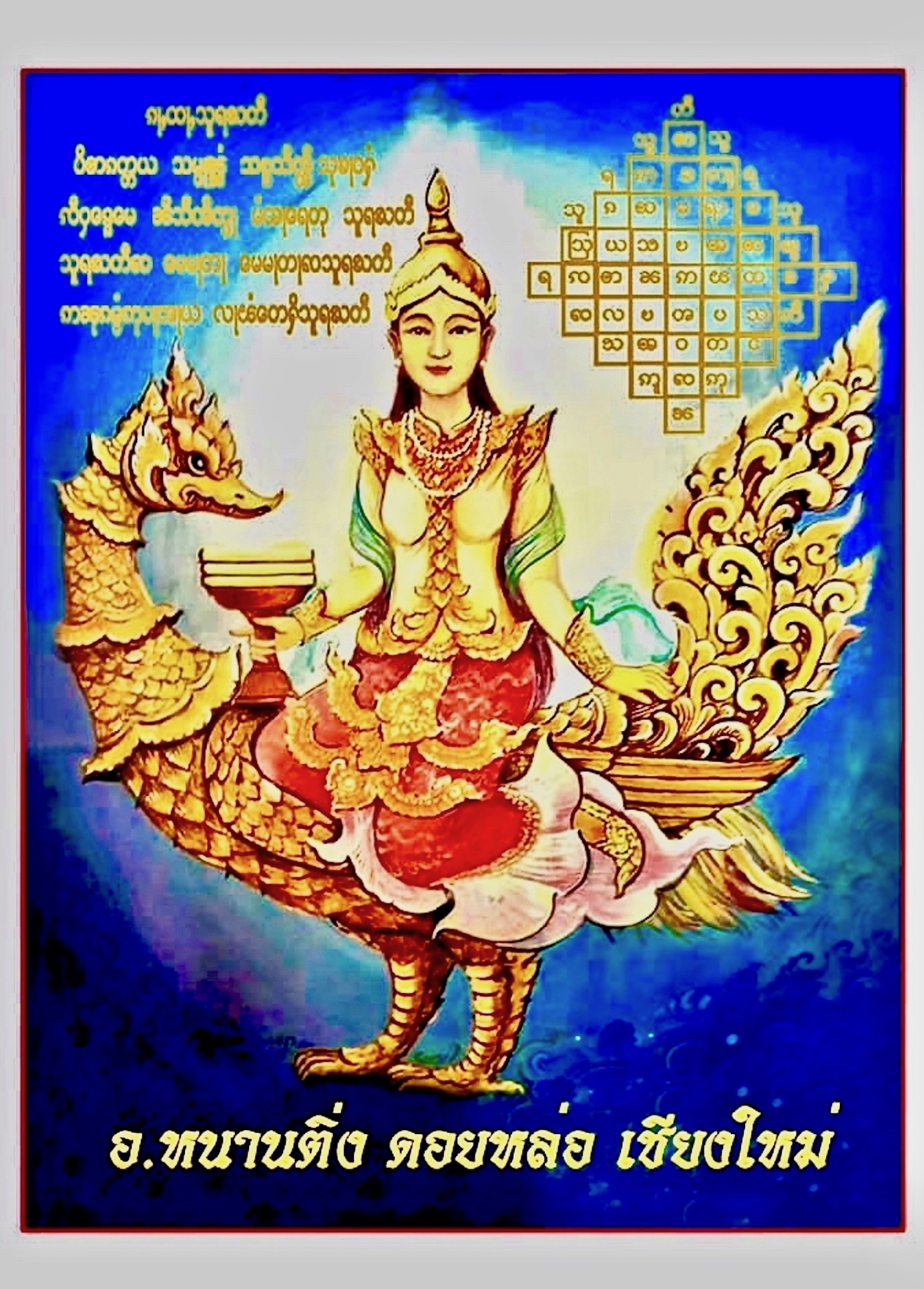
My own possession is another story. It began when I first heard music. Nothing has since equalled this possession of sound. My four pilgrimages to Thailand over the course of seven years saw me become possessed and inhabited by the deity Mae Surasatee. It was William Blake in The Marriage of Heaven and Hell that said, “Thus men forgot that All deities reside in the human breast.” 2. My love and devotion over the decades were a clear and open invitation to the deity Mae Surasatee to enter my body and life. Since Euterpe, the Muse in Greek mythology who presided over the art of music, musicians, and producers of all persuasions across time have drawn inspiration from all forms of deities, goddesses, and gods. The techniques and practices of invoking their presence and assistance in the creation and manifestation of art through rituals and spells are as countless as there are stars in the sky. In late September 2017 as I stepped off the plane at Bangkok airport I was to encounter and experience the arrival into my world of a deity that has quite literally changed the course of my life. While on my first pilgrimage (the second pilgrimage can be read here) can read to the temples and Ajarns of Northern Thailand I became initiated into the cult surrounding the beautiful Buddhist deity Mae Surasatee. An ‘Ajarn’ is a Thai language term, which translates as ‘professor’ or ‘teacher’. It is derived from the Pali word ācariya, and is a term of respect, similar in meaning to the Japanese sensei. Ajarn is a term that I personally recognize as magician.
I received my very first Sak Yant from Ajarn Nanting in September 2017. Sak Yant is a tattoo of profound magical power and can only be applied by a fully realized and recognized master of the art. The Thai word “Sak” means “to tap”, while the word Yant, derived from the Sanskrit word Yantra, means literally “machine” or “contraption”, a divine mystical diagram rich with occult meanings. Sak Yant uses sacred ancient Khmer or Khom alphabet to write Buddhist Sutras and other sublime hybrid spells using the Pali Sanskrit alphabet. Ajarn Nanting has had 28 masters pass on their profound magickal knowledge to him. Using the traditional Sak Yant rod, Ajarn Nanting applied an invisible tattoo made up of secret herbs and oils to my upper back dedicated to the magnificent Thai and Burmese deity Mae Surasatee, the deva that rides a swan. She is the deity in charge of and guardian of the Tripiṭaka, meaning “Triple Basket” the traditional term for ancient collections of Buddhist scriptures, universal knowledge, infinite wisdom, good luck, and music. Mae Surasatee is the direct descendant of the Hindu goddess Saraswati who is the Hindu goddess of knowledge, music, art, speech, wisdom, and learning. She is a part of the trinity (Tridevi) of Saraswati, Lakshmi, and Parvati. Saraswati translates from Sanskrit literally as “she who has ponds, lakes, and pooling water” or occasionally “she who possesses speech”. Ajarn Nanting has built over time a remarkable shrine specifically to Mae Surasatee from which he performs daily rituals for all that wish to have blessings dedicated to this deity. In January 2020 Ajarn Nanting gave me two permanent Mae Surasatee Sak Yants on my left and right shoulders in solid black ink. These two exactly similar ancient designs reflect numerous qualities that work together in tandem as a pair. The application of these two ancient Sak Yants in front of his shrine was then finished off with a blessing which took place underneath a sacred deep red cloth rich with diagrams, symbols and dedicate images dedicated to Mae Surasatee. Then a skull hat was placed on top of this cloth upon my head. It was a rather ornate and beautifully red initiation skull hat that resembled dragon’s scales. Red sequins and gold trimmed lining threaded this one of kind head wear. It had the vague look of a Tibetan Lama Buddhist head wear though much shorter and more highly decorated. During my January 2020 pilgrimage I was fixated, indeed somewhat possessed as if on a mission, that I needed to acquire a bucha (sacred statues with active magickal ingredients though this term does also initially mean ‘to praise or worship’) of Mae Surasatee. Peter Jenx, author and photographer of the Thai Occult book series and myself had planned to drive to Mae Sot, a city on the Thailand and Myanmar to acquire the said bucha and to visit some very old shops that might yield some hidden treasures. When it came to the punch I’d realised that I had depleted by budget and couldn’t go on this planned excursion. In a piece of serendipitous coincidence this idea became welcomingly redundant. While at Ajarn Nanting’s samnak (an Ajarn’s place of work, ritual, and a fully consecrated shrine) I saw that Ajarn had a small but extremely beautiful wooden and gold leaf covered bucha to Mae Surasatee underneath a glass case which was for sale alongside other incredible amulets, perfumes and a substance called See Pung, which is a form of enchanted magical beeswax. The bucha had been blessed many times by various Ajarns and venerated masters. Mae Surasatee’s countenance glowed like the sun. The golden swan upon which she rode and the exquisite motives across this highly magnetic artefact swallowed me whole. I asked how much this remarkable bucha was, placed the requested sum into a giving bowl and then worshipped at his shrine.
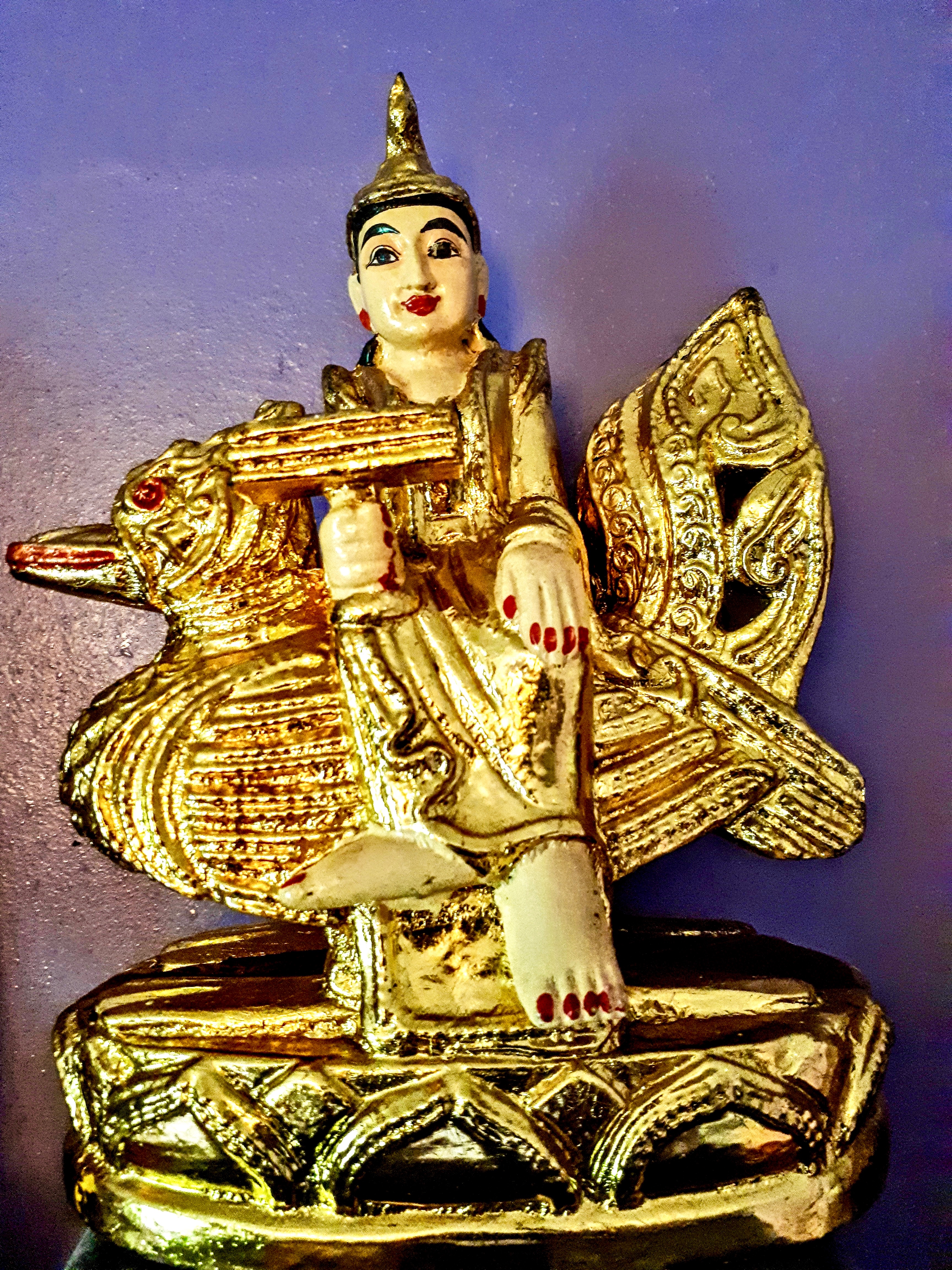
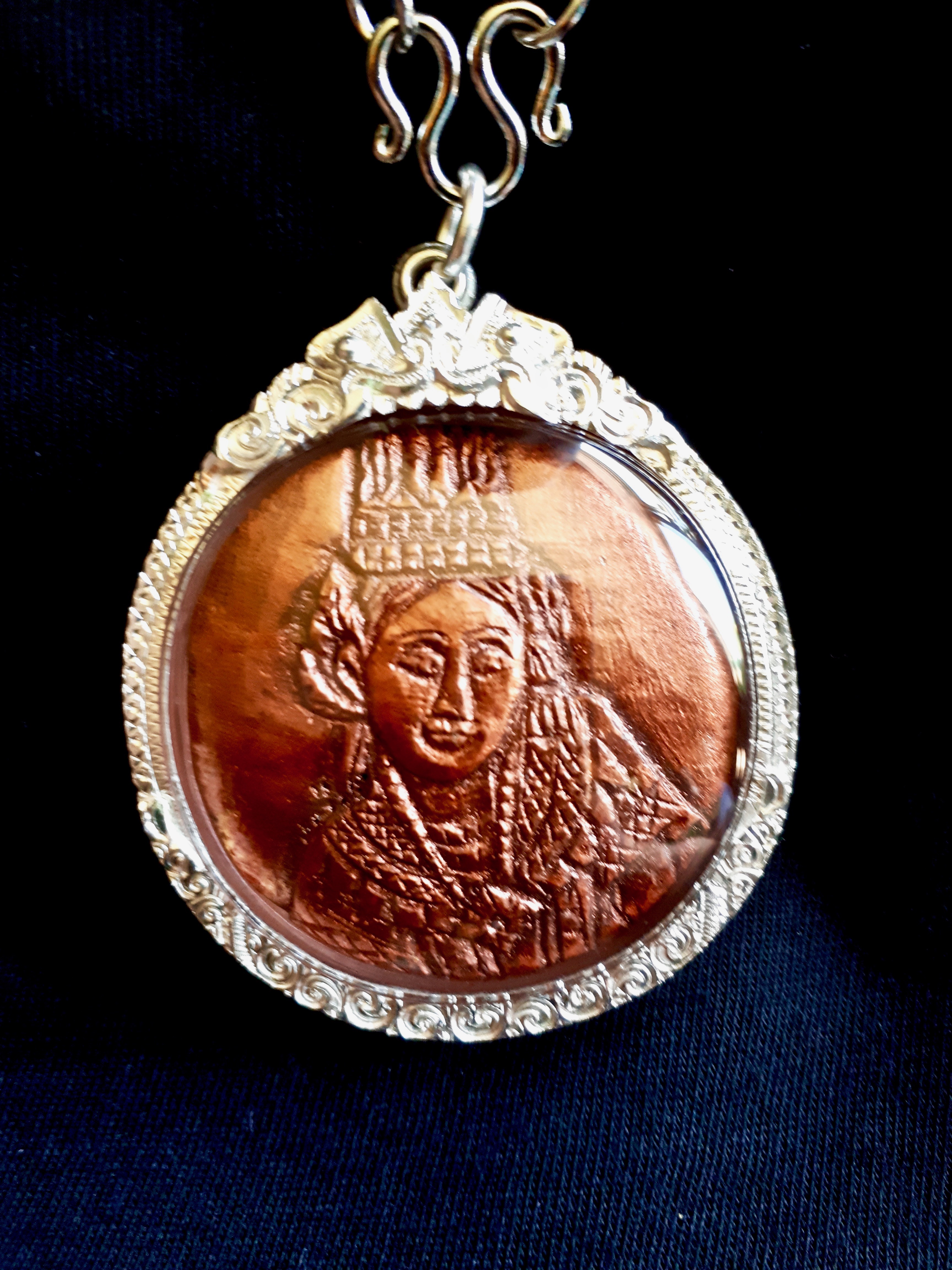
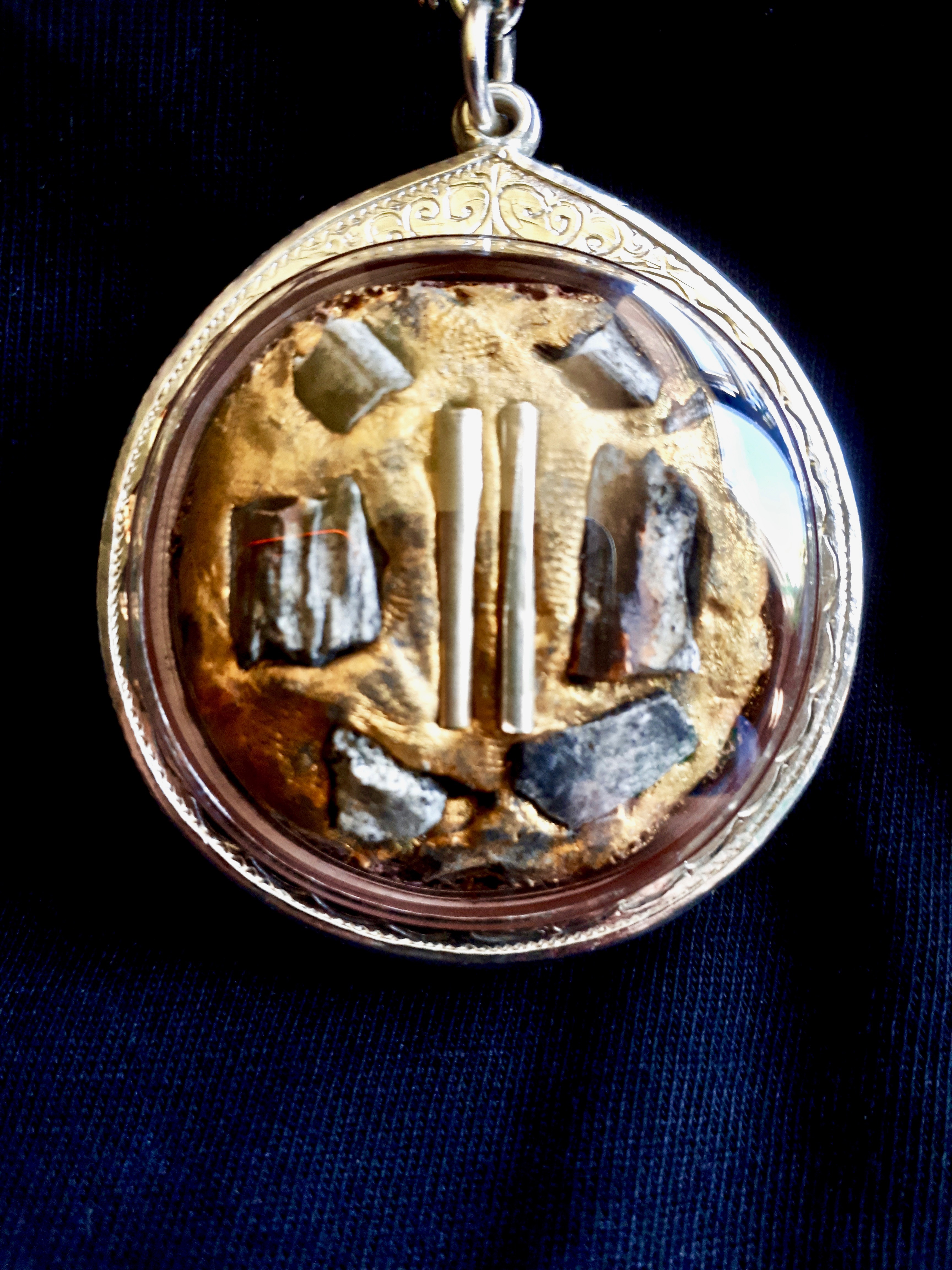
I have a fully-fledged Thai Lanna Buddhist style shrine in my home. There I perform my daily practice of meditating, chanting, and making regular offerings to each of the deities and spirits that I commune with which includes in the centre pride of place Mae Surasatee. Since my inked Mae Surasatee Sak Yant’s she quite literally has my back. Her holy and sacred presence is always with me. I own three Mae Surasatee amulets. One is by Ajarn Nanting which has been created using a blend of magical herbs and a takrut (a sacred magical scroll usually in various metals upon which yantra are inscribed). The other amulet is by a sublime practitioner called Phra Ajarn O Putthoraksar. This smaller and more compact amulet has gone through a secret process of creation which has been handed down through an ancient cult and Burmese linage of Khru Surasatee. An original mixture of earths and plants has been used and are bound together in a pressing which make up and constitute her very essence and presence. The third amulet is probably far more connected to spiritual possession in its scope and features an aspect of necromancy that Western minds may find somewhat disconcerting. The Mae Surasatee panneng amulet by Ajarn Tay is a remarkable and sublime amulet that I wear on a regular basis. A panneng is the third eye region of a human skull. This amulet has four pieces of what is called a Phi Tai Hong female bone that surround two takrut spells which is then set inside a matrix of graveyard earth and bone powders. Appropriate offerings to Mae Surasatee include green bananas, unopened coconuts, pineapple fruit and once a year an unopened jar of honey is to be placed beside her. Sweet smelling flowers placed near her are also a requirement, something which I undertake once a week. Perfume is another offering that Mae Surasatee enjoys and responds to. Invoking her spirit through sensuous such offerings increases levels of luck, pleasure and good fortune which emanate from your devotion to her. Numerous requests can be made to her ranging from success in love, increases in wealth, assistance in improving studying and intellectual pursuits, improvement, and development of samādhi (various a state of meditative consciousness the development of a luminous mind which is equanimous and mindful) and the granting of wishes. I have seen first-hand how persistent selfless devotion to this magnificent deity has filled my life with remarkable inspiration and good fortune. I am completely devoted to her and praise her through my work as much as I can.
My album Gateway to the Goddess is one such devotional act. This two-track album of luxuriant immersive electronic music journeys through various moods and vistas. Gateway to the Goddess pays homage and is lovingly dedicated to my mother and Olivia Robertson, author, artist, co-founder, and high priestess of the Fellowship of Isis (a peaceful society honouring the Goddesses of all cultures, races, and religions) and finally but by no means least to the magnificent and praiseworthy Thai and Burmese Buddhist deity Mae Surasatee, Goddess of knowledge, music, art, wisdom, and learning. Since allowing Mae Surasatee into my life a profound and continuous internal shift has occurred. Embracing this deity into my life has for all intents and purposes made my burdens lighter and easier to manage while extending my patience. My practice has benefitted considerably and my music and personal focus in terms of productivity along with it. I am now capable of prolonged periods of single pointed focus which have now manifest into the audio work I produce. It’s frighteningly easy for me to completely lose sight of myself and see all track of linear time disappear. Entering a relationship with a deity such as Mae Surasatee is akin to opening a portal from which there can be no return. Since my enchantment and initiation into this cult I have become another person completely.
In his quote surrounding the subject Carl Jung described Satori thus, “Satori comes upon one unawares, as something utterly unexpected. It implies an insight into the nature of self. Satori is the most intimate individual experience. We can never know if a person has a Satori or whether he merely imagine it.” And so possession itself can also be seen in such a light. Unbeknownst to us the possession of spirit or whatever labelling we could muster creeps gently into us without a whisper or sound. D. T. Suzuki from his book An Introduction to Zen Buddhism states, “There is something rejuvenating in the possession of Zen. The spring flowers look prettier, and the mountain stream runs cooler and more transparent. The subjective revolution that brings about this state of things cannot be called abnormal. When life becomes more enjoyable and its expense broadens to include the universe itself, there must be something in Satori that is quite precious and well worth one’s striving after.” 3
I feel that the experience of Satori is a living relative to the idea of possession and can be an important mechanism in ecstatic experience. The connotation of possession is usually seen in a negative light in the media through films, music, and books. I think it is a very long time overdue that we as healers take back this idea for the good that it can truly be seen as and bring its identification away from the views of anguished spiritual imprisonment, irrational otherness and monotheistic shame and guilt that are so firmly entrenched and move it more towards the life changing, integrated, inclusive and community based transformative tool of enlightenment that we all know it to be able to become and ultimately be.
References
1. S.M. Shirokogoroff. Psychomental Complex of the Tungus. London: b Kegan, Paul, Trench, Trubner (1935). Digitised by Wellcome Library at https://archive.org/details/b31367033/mode/2up
2. William Blake (1757–1827). The Marriage of Heaven and Hell (probably created 1790).
3. D.T. Suzuki. An Introduction to Zen Buddhism. Eastern Buddhist Society (1934).
This article was first published in issue 50 of Indie Shaman Magazine.
 Sheer Zed ~ Author • Buddhist Shaman • Musician