
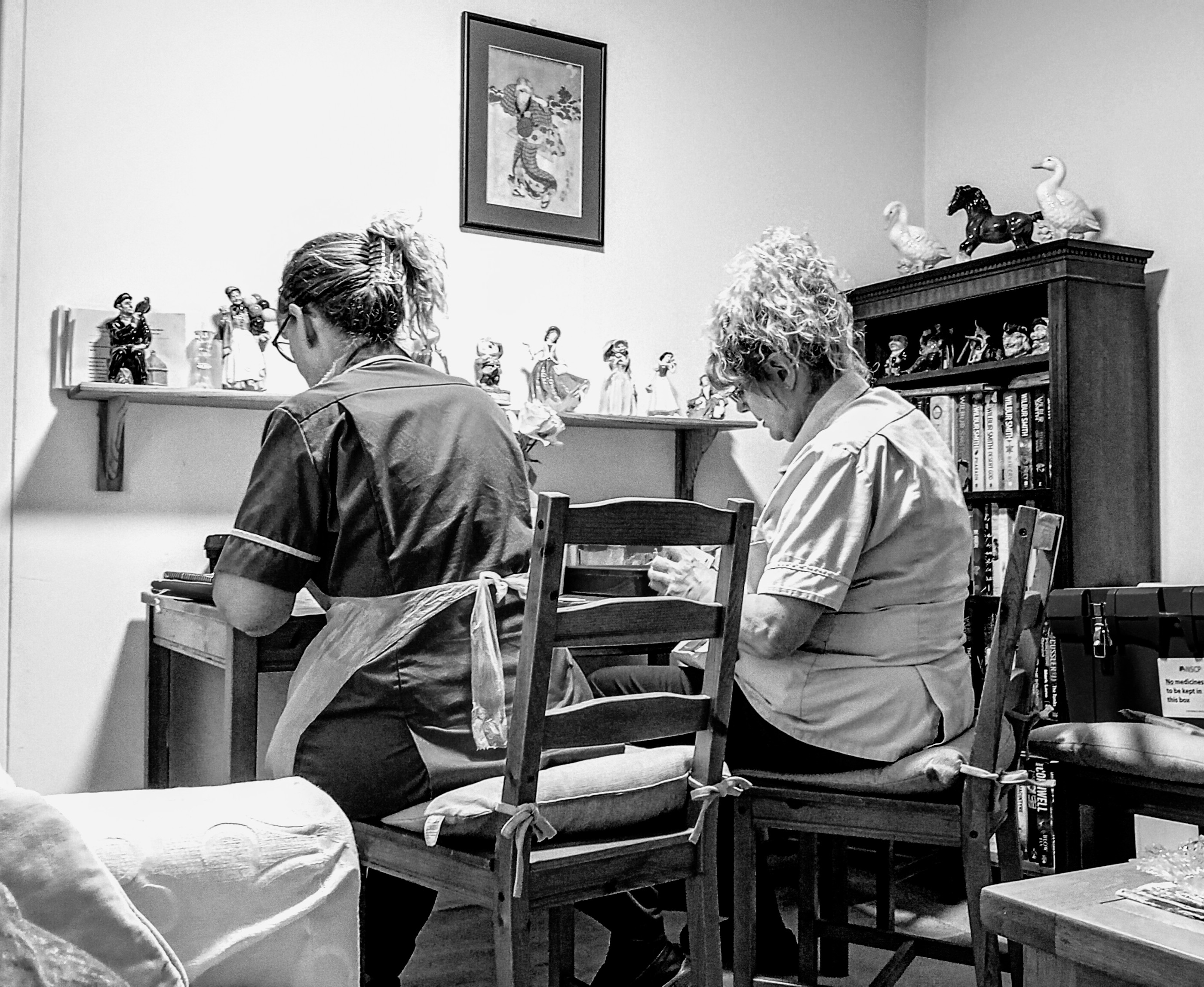
What is a syringe pump? According to the Marie Curie website; “A syringe pump is a small, battery-powered pump that delivers medication subcutaneously (under the skin) at a constant rate over a 24-hour period.” This may sound straight forward and pretty much an innocuous device that does its job which can help alleviate severe symptoms for a chronically ill patient. And so it does. And yet what they don’t tell you is that the syringe pump like any other mechanical device needs constant maintenance and consistent attention when attached to a patient. The patient is my mother. The condition is terminal cancer. The syringe pump is loaded with and slowly dispenses a cocktail of drugs that keeps my mother in a comfortable and stable state. Late on a Sunday evening in a simple and a momentary mishap the line going into my mother’s arm came out. I thought at this point I would panic but surprisingly I did not. I immediately called the phone number for the district nurses and was told that they would be with me and my mother in roughly two hours. The district nurses have a large pool of patients that they care for, especially at night, and if you figure in travelling time (which in this case was from Weston-super-Mare) it would take roughly two hours and indeed they arrived on time to re-establish and re-load the syringe pump for my mother. The Marie Curie website mentions further that “syringe pumps for palliative care are programmed to deliver the medicines over a 24-hour period, so a new syringe of medicines will be set up once per day, at the same time each day.” At 12 noon the district nurses like clockwork arrive to refresh the syringe pump. Indeed, these remarkable, disciplined, kind, and highly professional people are very often overlooked and supply critical support to a myriad of folk across the country. I wonder why the government have such a violent reaction against such individuals, that are in essence doing nothing but caring for and maintaining the very citizens that have paid taxes to support the ongoing presence of these profoundly courageous and industrious women.
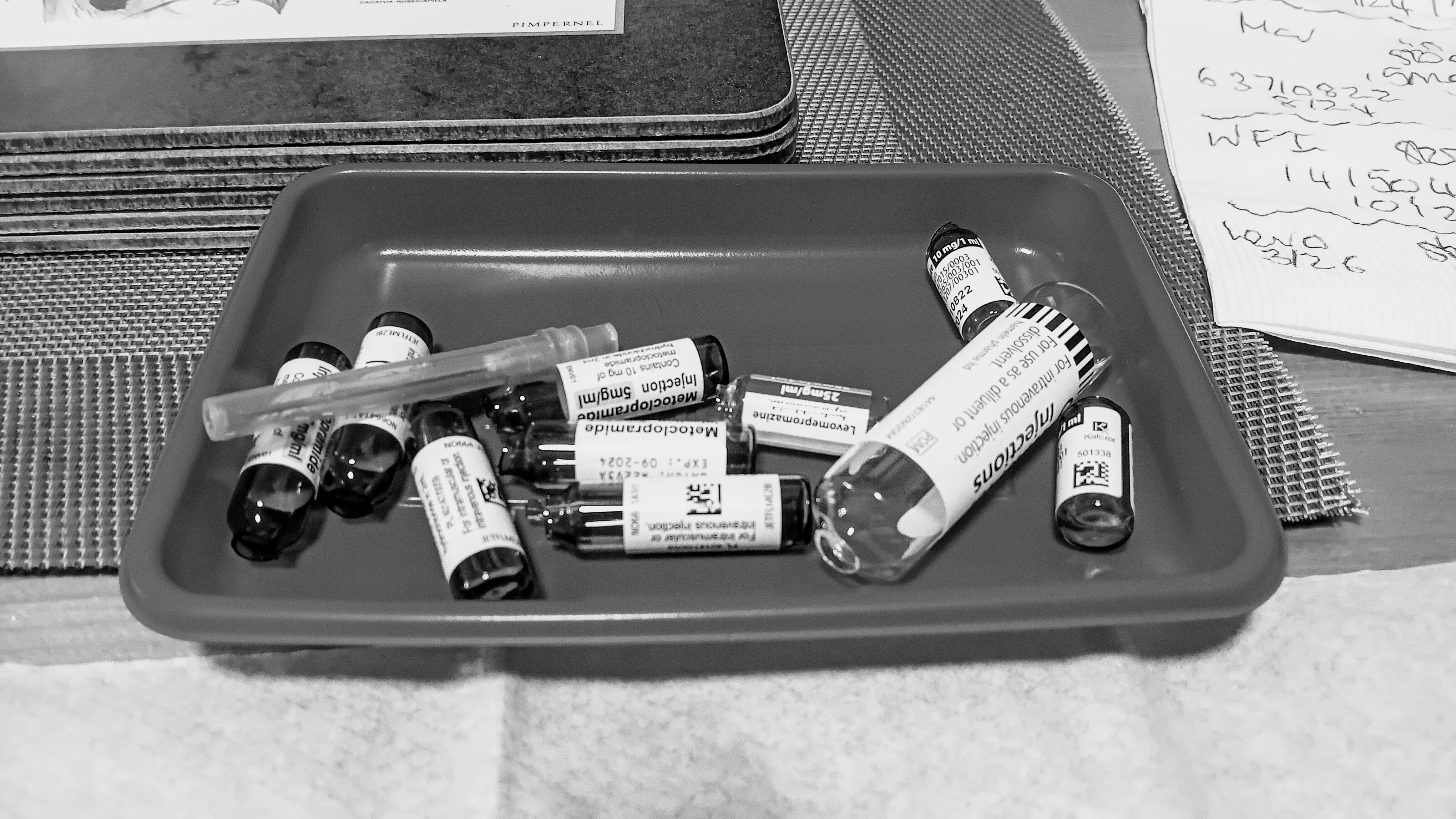
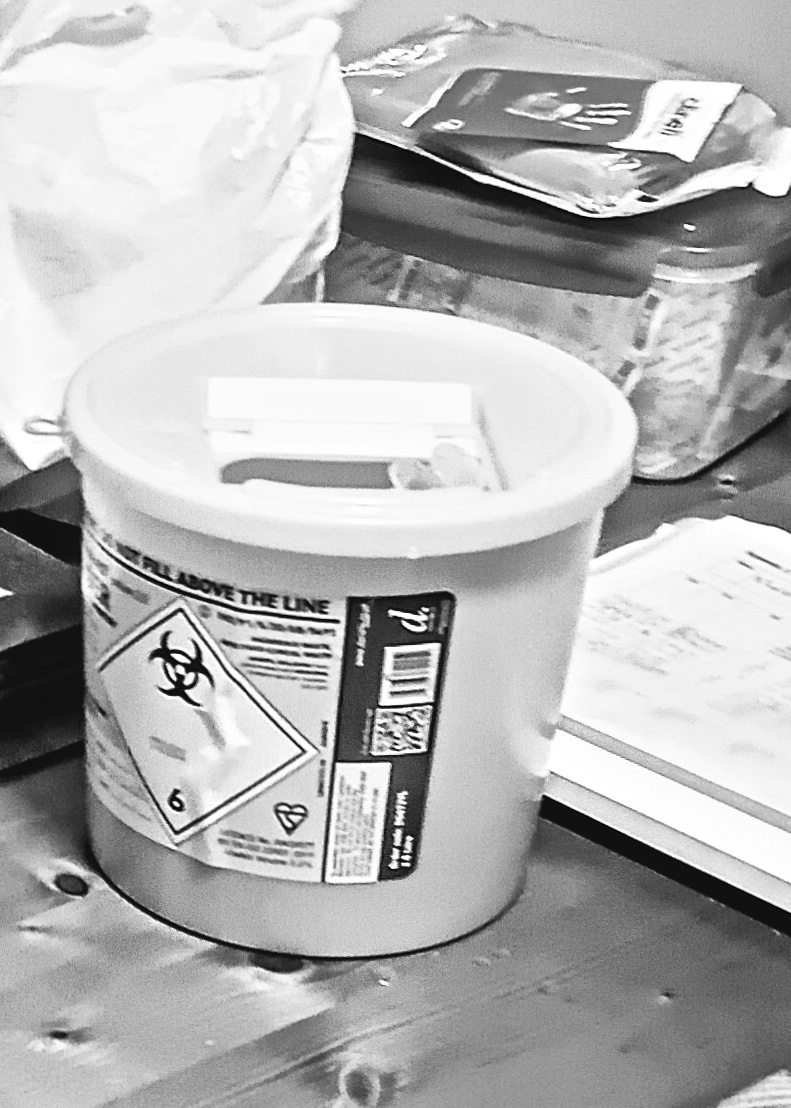
Something that I have found somewhat surprising is the amount of clinical waste that is produced from just one patient. It’s a lot. Particularly if that patient is dying. This is not in any way a criticism of the patient or the system of delivery that eases the patient’s pain and suffering. It’s just an observation. Indeed I was surprised that irrespective of how kind and caring the district nurses are they simply cannot take complete control of all of the clinical waste that is created by the one you are caring for. I have carefully binned the neatly bagged items the district nurses have given to me into the usual household waste disposal. It’s something called “sharps” however that takes an extra step from yourself in order to dispose of this in the correct and proper manner. The NHS website states; “A sharps bin is a specially designed box with a lid that you can get on prescription (FP10 prescription form) from a GP or pharmacist. When full, the box may be collected for disposal by your local council.” I called North Somerset Council. It was relatively straight forward to establish a clinical waste collection from our home. The full sharps bucket was left out by myself as instructed by the council on a Sunday night and like the tooth fairy in reverse the sharps bucket was removed on a Monday morning with a fresh and brand new empty sharps bucket left in its place. During this second week of supplying palliative care for my mother I have been wearing and working with the Pra Pidta Ruay Pan Lan Ongk Kroo Pim B Nuea Fa Pasom Pong Graduk Phii 3 Takrut Chakra Disk amulet by Pra Maha Somporn. This immense and extremely helpful amulet is very good for protection and attraction, which is very useful indeed when one is trying to establish a regular collection of clinical waste from your home. The hands over the eyes in this amulet symbolize the blocking of all negative aspects of the outside world during meditation and Nirodha, (“cessation,” or “extinction”) referring to the cessation or renouncing of craving and desire. The Phra Pidtaa amulet is essentially a Buddhist symbol, and a form of talismanic magic. On the back of this particular Pra Pidta is a separately powered special amulet that has a Vishnu Chakra border and the Chinese Horoscope Wheel of Fortune with a Lion Dog in the centre with the words “Gan Chong” (meaning either prevent bad luck or the spirit to break through or courage and daring) written upon it. It is wise when multi-tasking, managing, and liaising with numerous different contacts within various institutions to employ all manner of sublime methods that facilitate positive outcomes. My daily morning practice is the bedrock of my day, but it is the small and detail orientated placements of magickal items and the specific decisions relating to this particular addition that can make or break many seemingly random or chaotic situations.
 Sheer Zed ~ Author • Buddhist Shaman • Musician